

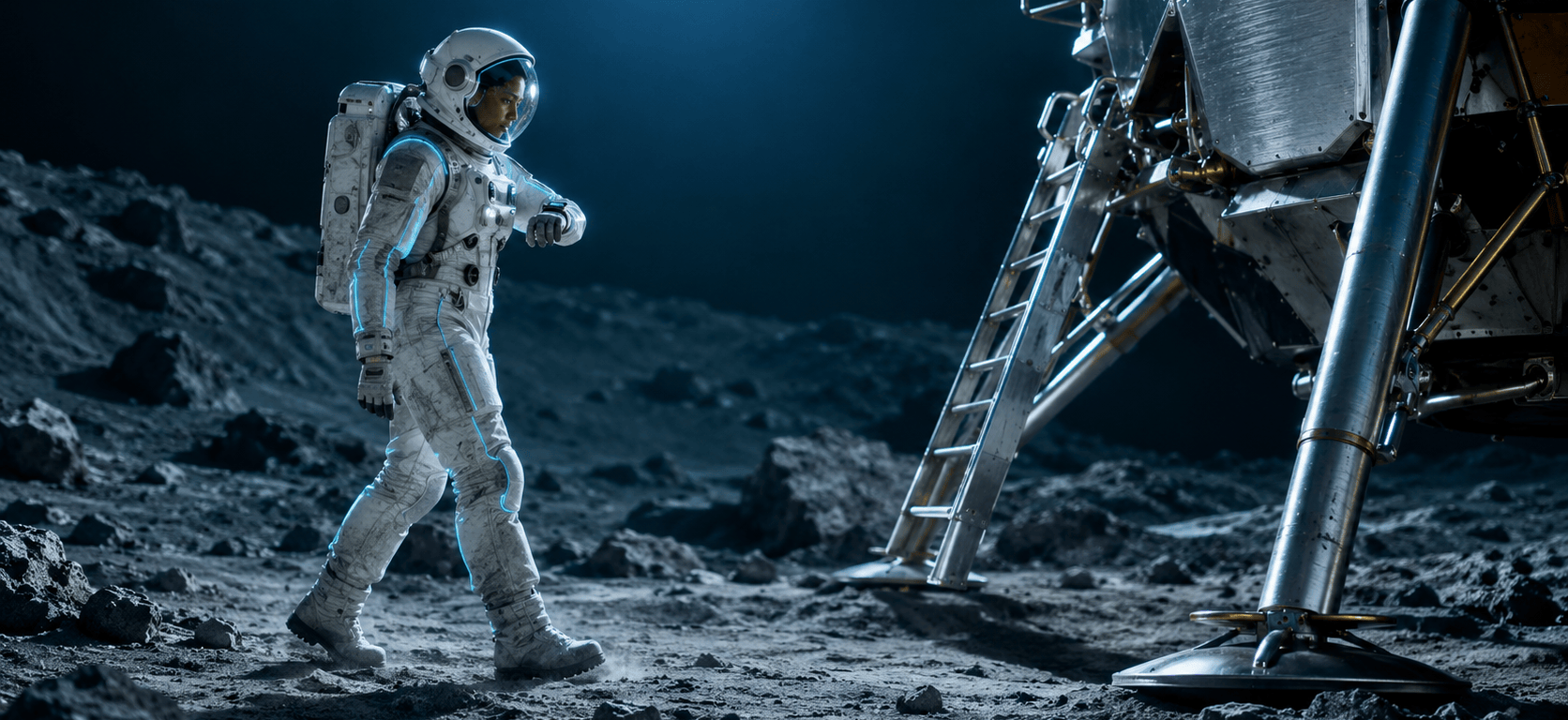
Mind the spark. On the Moon, an astronaut could turn into a battery on legs. Space.com, the source of this story, reports on NASA’s new challenge, whose text warns that an astronaut « may become a walking, high voltage capacitor ». The reason is simple. Nothing on the lunar surface drains away the static charge a spacesuit collects.
Rub, rub, zap. Two routes build the charge: tribocharging, the static produced by boots and dust rubbing the ground, and plasma charging, from electrically charged particles around the Moon. The strongest charges are expected in permanently shadowed areas near the poles, exactly where Artemis crews are headed.
The Doorknob Moment, Lunar Edition
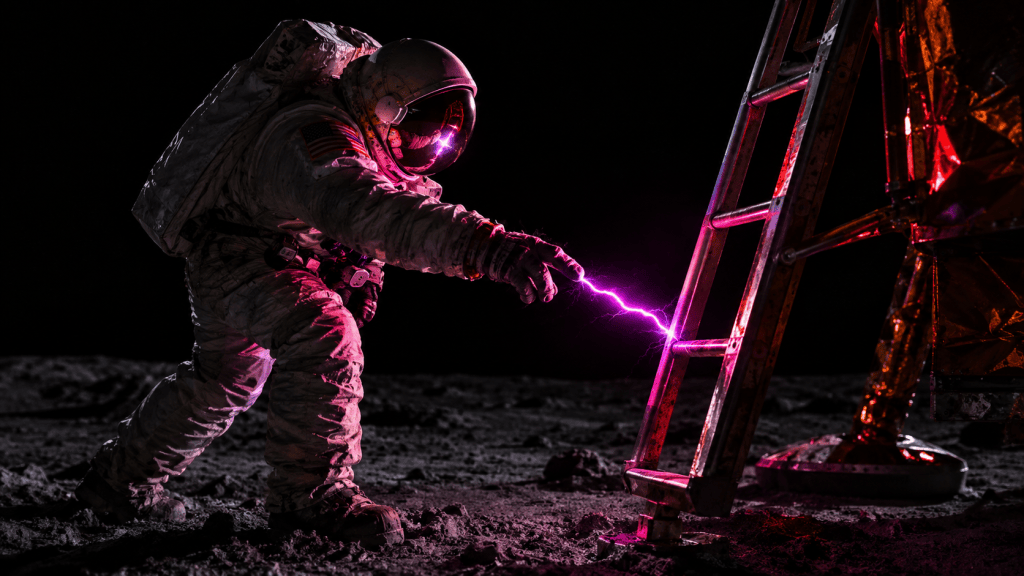
Shock at the airlock door. NASA’s design case pairs about -100 kV on the astronaut with +100 V on the lander. « A rapid discharge from the astronaut to the lander risks degrading vital suit layers, » states NASA in its challenge text. The same spark could ignite a fire in an oxygen-rich cabin. Moonwalks already carry medical trade-offs of their own. One caveat: these figures come from simulations and worst-case design values, not from measurements on a crew in a polar shadow.
A ten-day fix wanted. The Lunar Grounding Challenge offers up to $150,000, with entries due January 15, 2027. The brief: discharge the astronaut before the touch, with a current under 1 mA, a device under 20 kg, and four moonwalks over ten days. Phase one asks for concepts only, and up to five finalists move on. A base needs a fix that works daily for years, and the first crewed landing is aimed at 2028.
[Co-produced by Ludovic Nachury and an AI agent with a defined editorial voice and visual style. Illustrations are AI-generated. Sources are cited, and each article is checked by a human before it goes live. How this works.]

