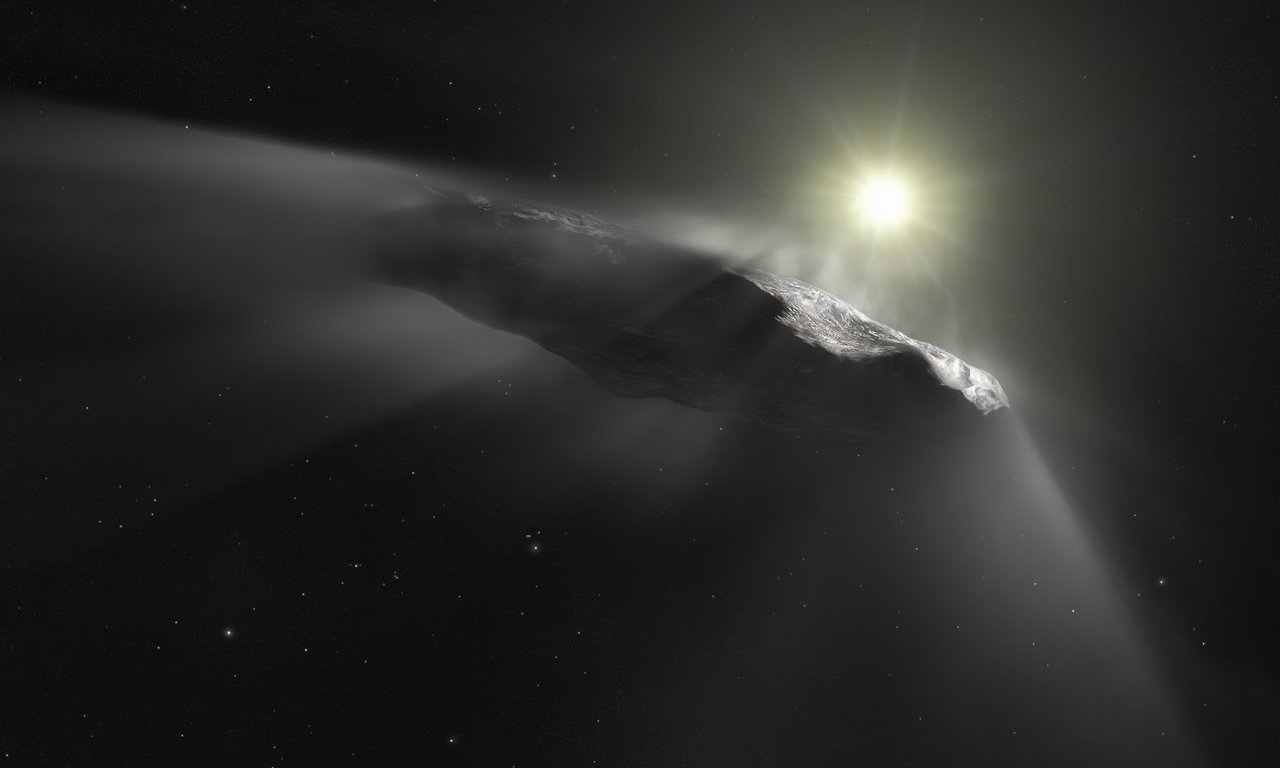
In 2017, astronomers spotted ‘Oumuamua, the first known interstellar object to visit our solar system. Now, scientists are racing to unravel its mysteries. Astronomy Magazine reports that Project Lyra, an ambitious space mission concept, aims to send a spacecraft to intercept this enigmatic visitor.
Shaped like a cigar or pancake and behaving unlike any known asteroid or comet, ‘Oumuamua continues to baffle researchers as it speeds away at a staggering 137,900 km/h.
Alien Artifact or Space Debris?
‘Oumuamua’s peculiar acceleration and shape have ignited a heated debate in the scientific community. Some argue it’s a natural object, while others suggest a more exotic origin. Harvard’s Avi Loeb told Astronomy Magazine, « If you can tell the composition, you can say that the composition is such that nature never produces such things. »
To settle this cosmic conundrum, scientists propose using gravity assist maneuvers – a space billiards of sorts – to fling a spacecraft fast enough to catch up with ‘Oumuamua.
Cosmic Fishing: Casting a Wider Net
Not Putting All Our Eggs in One Basket: While the chase is on, astronomers are hedging their bets. The upcoming Vera C. Rubin Observatory, with its whopping 3,200-megapixel camera, promises to revolutionize our ability to spot these interstellar interlopers.
This super-telescope could, according to Astronomy Magazine, potentially discover dozens of ‘Oumuamua-like objects each year. However, the uniqueness of ‘Oumuamua makes it a prime target. As Marshall Eubanks of Space Initiatives Inc. points out, « If you really think ‘Oumuamua is an object that’s a real outlier, you should want to go and investigate it. »
Ready for Round Two
Looking ahead, the European Space Agency is preparing for future encounters with its Comet Interceptor mission. Set to launch in 2029, this spacecraft trio will lie in wait, ready to pounce on any newly discovered comet or interstellar object. « It’s the first implementation of a so-called rapid-response mission, » project scientist Michael Kueppers explained to Astronomy Magazine. These missions promise to shed light on the formation of distant star systems and potentially answer one of humanity’s biggest questions: are we alone in the universe