
Lunar gold rush looms. As space agencies and private companies set their sights on the moon, scientists are sounding the alarm about the need for international cooperation. According to a recent column from Space.com, experts are calling for a coordinated plan to regulate and share lunar resources, particularly the much-coveted water ice at the lunar south pole. This push comes as NASA’s Artemis program aims to leverage these resources for sustaining human presence on Earth’s celestial neighbor.
Confusion reigns in lunar lexicon. The excitement surrounding lunar exploration has led to a misuse of terminology, with « resource » and « reserve » often used interchangeably in discussions about moon materials. Clive Neal, a lunar exploration expert from the University of Notre Dame, explains to Space.com, « Based upon current knowledge and likely users, the only potential lunar reserve is oxygen from regolith as it is present in about the same proportion anywhere on the moon. »
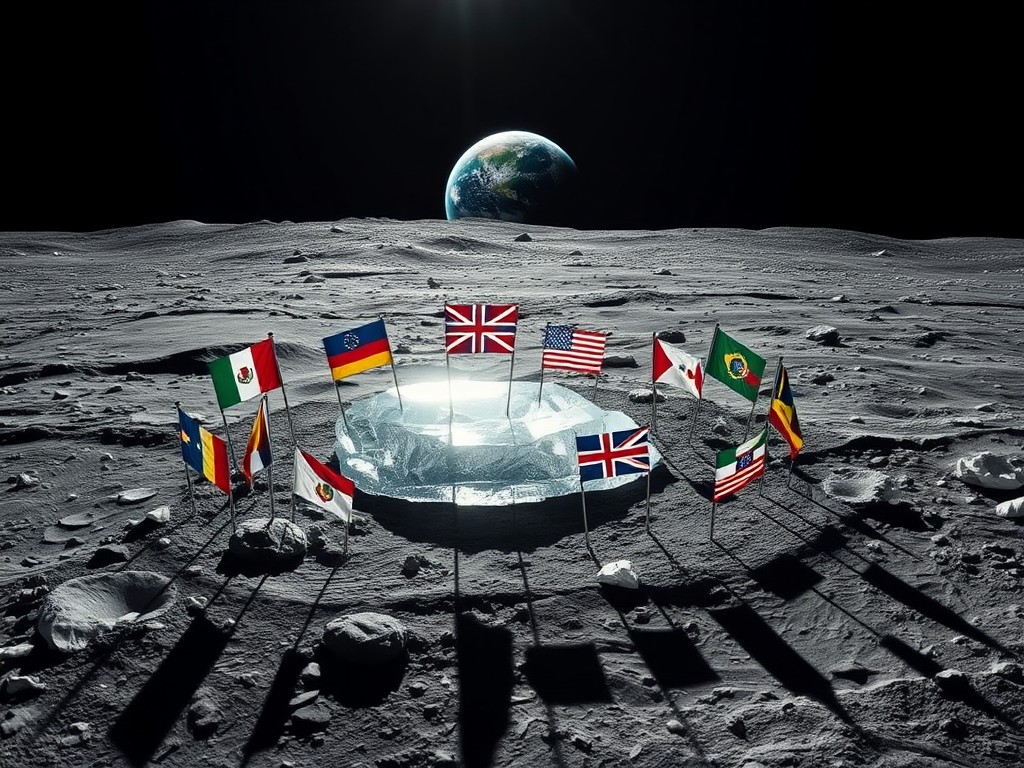
To address this confusion and promote collaboration, Neal proposes an International Lunar Resources Prospecting Campaign (ILRPC). « We need to formalize this campaign in terms of getting people onboard, to take it seriously. It’s time for collaboration and cooperation, » Neal tells Space.com.
One Small Step for Regulation
Lunar missions aplenty. As the race to the moon heats up, a flurry of missions are underway or in development. Currently, NASA’s veteran Lunar Reconnaissance Orbiter and the Korean Pathfinder Lunar Orbiter are circling the moon, studying its polar regions. These missions, along with India’s Chandrayaan-2 orbital component, are providing valuable data about lunar volatiles. Looking ahead, NASA’s Lunar Trailblazer and the collaborative LUnar Polar EXploration (LUPEX) mission from Japan and India are set to further our understanding of the moon’s resources.
Global players eye lunar prizes. The moon’s potential isn’t lost on global powers. China and Russia are working on their own robotic missions to investigate the south pole for volatile resources, as part of their plans for an International Lunar Research Station. With 30 funded robotic lunar missions under development and 16 more proposed, the next decade promises a wealth of lunar data.
As Neal points out to Space.com, « This is where science and exploration come together. Everybody wins if science and exploration go together. » As these missions unfold, the need for international cooperation and clear regulations becomes increasingly critical to ensure equitable and sustainable use of lunar resources.