

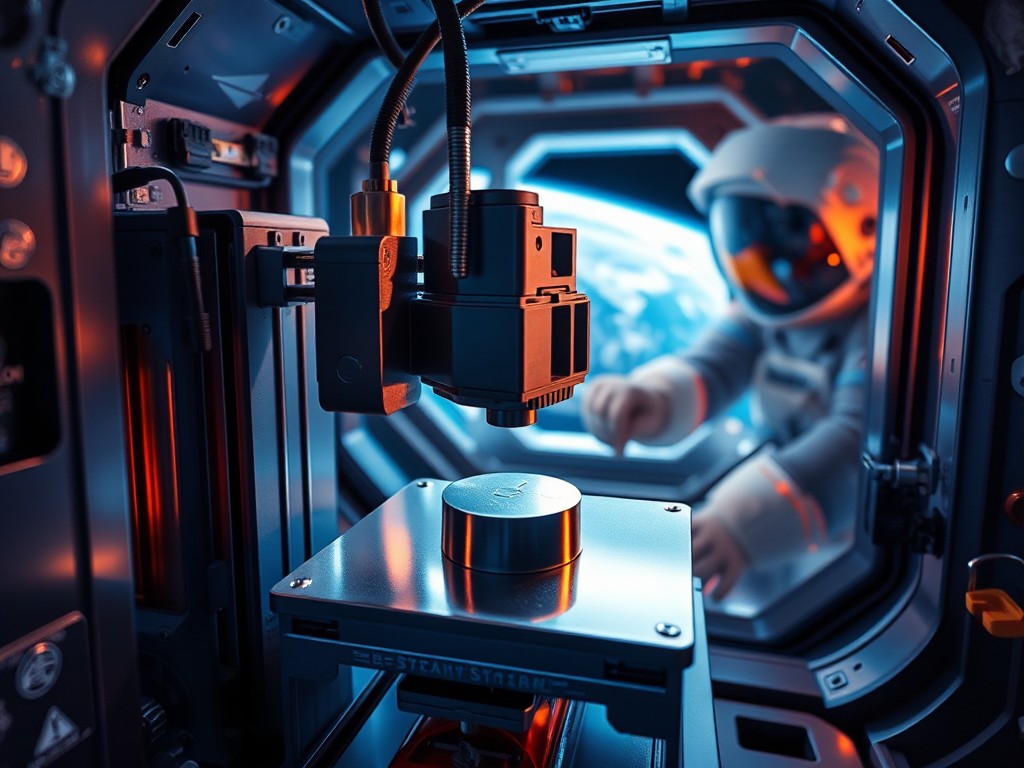
Astronauts aboard the International Space Station (ISS) have successfully 3D-printed the first-ever metal part entirely in space. This groundbreaking achievement, reported by TheNextWeb, marks a significant milestone in space manufacturing capabilities. The European Space Agency (ESA) and Airbus collaborated on this project.
Size matters, even in space. Engineers had to radically redesign traditional metal 3D printers to function in the unique environment of space. The 180kg printer, developed by Airbus, was shrunk down to the size of a washing machine to fit within the ISS’s tight confines. It’s capable of producing parts up to 9cm high and 5cm wide, with each print taking approximately 40 hours.
To protect the ISS from the extreme heat generated during the printing process, the device was encased in a sealed, metal safe-like box. ESA astronaut Andreas Mogensen installed this innovative printer in the ISS’s Columbus module earlier this year.
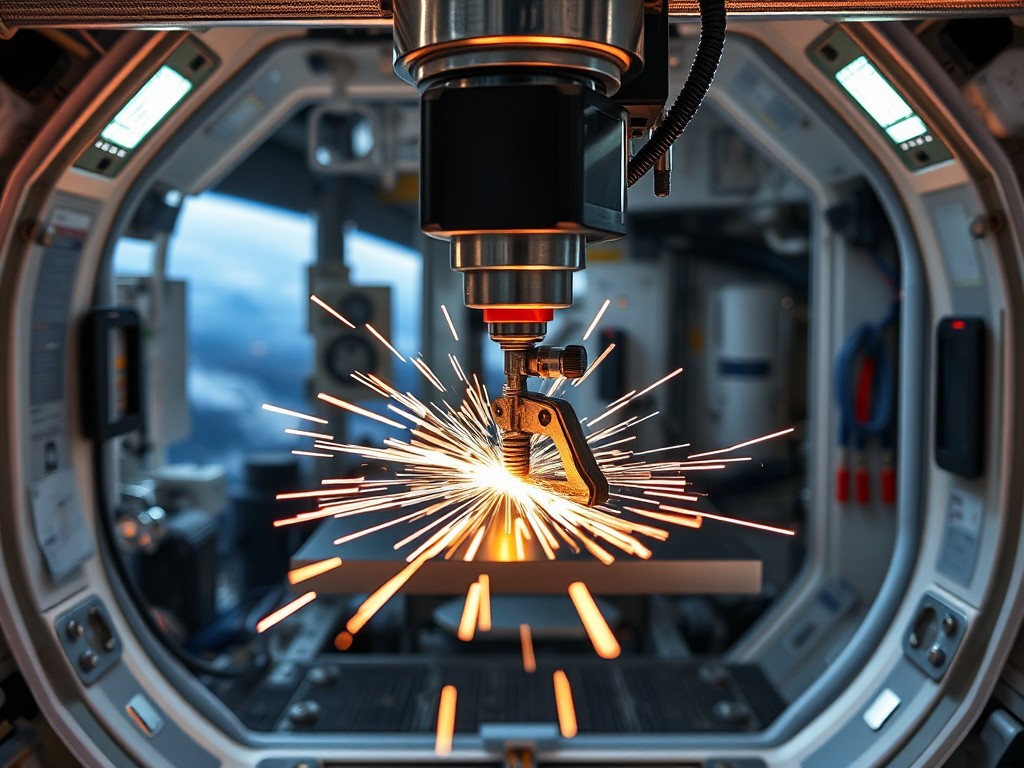
Defying gravity: The future of cosmic construction
Who needs Earth when you can print in space? Unlike previous plastic-based 3D printing experiments on the ISS, this demonstration proves it’s possible to create durable, high-strength parts in microgravity. « Creating spare parts, construction components, and tools on demand will be essential for long-distance and long-duration missions, » explained Daniel Neuenschwander, director of human and robotic exploration at ESA, to TheNextWeb.
The printer uses wire-based technology, a crucial innovation for managing gravity in space. As Sébastien Girault, metal 3D printer system engineer at Airbus, told earlier this year, « The wire is independent of gravity unlike the powder-based system, which always has to fall to the ground. »
From science fiction to space fact. This breakthrough could significantly reduce future missions’ reliance on Earth-based supply chains. It paves the way for greater autonomy in space exploration, allowing astronauts to manufacture essential tools and components on-demand. While this represents a major step forward, it’s worth noting that other space agencies are also making strides in this field.
NASA and ESA are developing 3D printing technologies that could use local resources like lunar regolith for space construction, further reducing the need to transport materials from Earth. The successful creation of the first metal part in space demonstrates that durable, high-strength components can now be manufactured in orbit. This capability could prove invaluable for long-term missions to the Moon, Mars, and beyond.