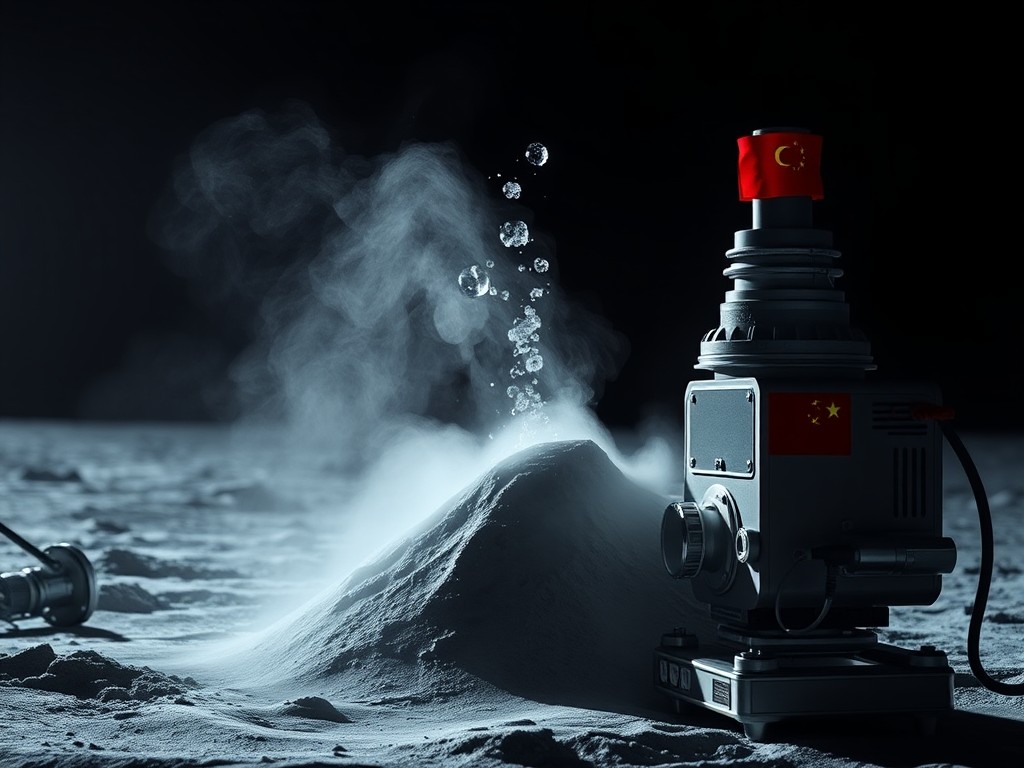
Moonshot miracle? Chinese scientists have unveiled a novel method to produce substantial quantities of water using lunar soil. This discovery, reported by Reuters, stems from samples collected during China’s 2020 Chang’e-5 mission, marking the first lunar sample retrieval in over four decades.
Moon rocks hide H2O secrets. The innovative technique, developed by researchers at the Chinese Academy of Sciences, involves heating lunar soil minerals rich in hydrogen to extreme temperatures. This process triggers a reaction that releases water vapor, effectively transforming moon dust into a potential lifeline for future lunar inhabitants.
As reported by CCTV, « After three years of in-depth research and repeated verification, a brand-new method of using lunar soil to produce large amounts of water was discovered, which is expected to provide important design basis for the construction of future lunar scientific research stations and space stations. » The efficiency of this method is remarkable, with one tonne of lunar soil capable of yielding 51-76 kg of water – enough to fill more than 100 standard water bottles or sustain the daily drinking needs of 50 people.
Lunar Dreams and Earthly Rivalries
Space race heats up. This breakthrough could prove instrumental in China’s ambitious plans to establish a sustainable presence on the moon. The nation has set its sights on constructing a « basic station » at the lunar south pole by 2035, followed by a moon-orbiting space station a decade later. These goals form part of the broader International Lunar Research Station (ILRS) initiative, co-led by China and Russia. While China forges ahead with its lunar aspirations, it’s worth noting that space exploration remains a competitive field. Other nations, including the United States, are also striving to unlock the moon’s resources and potential.
Cosmic game-changer? The implications of this water production method extend far beyond sustaining human life on the moon. NASA Administrator Bill Nelson has highlighted the potential of lunar water as a source of hydrogen rocket fuel. This could transform space travel, enabling missions to Mars and beyond by providing a refueling station right on our celestial neighbor.