
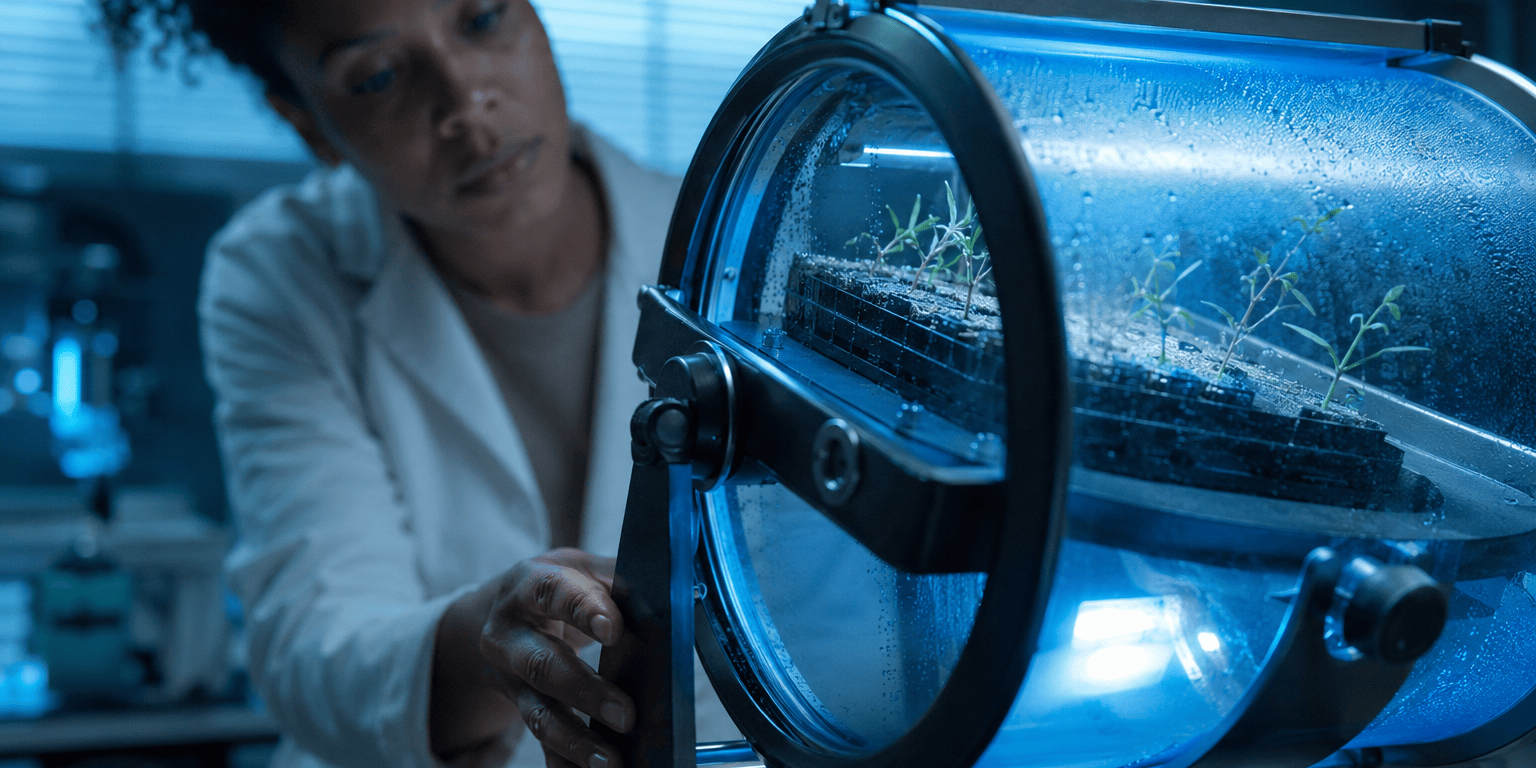
Some space farming starts on the ground. According to the Italian news agency AISE, an Italy-Brazil-Angola partnership coordinated by the IILA organisation, backed by Italy’s foreign ministry, has opened its first phase of work on space agriculture. None of it happens in orbit: the phase runs in an agronomy lab at the University of São Paulo’s ESALQ school, where researchers use machines that simulate weightlessness on the ground to watch seeds germinate and grow without it.
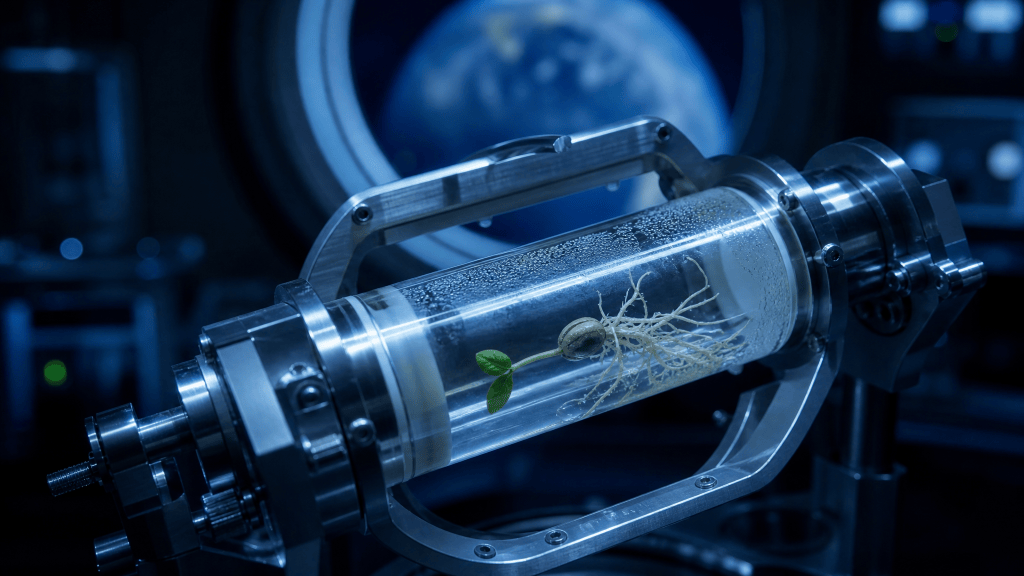
Faking microgravity is a bargain. A bench device that keeps a plant tumbling so it never senses which way is down costs a fraction of a launch, letting ESALQ track physiological and metabolic responses across many runs. The limit is built in: China’s Tiangong station is already growing rice through successive generations in real orbit, and the question that matters most for long missions, whether prolonged weightlessness leaves a plant’s genetic stability intact, cannot be settled on a laboratory clinostat.
Bringing Angola Into the Greenhouse
The guest list is the surprising part. Angola takes part through the Cuanza Sul polytechnic, alongside Brazil’s EMBRAPA, ESALQ and AEB space agency and Italy’s ENEA and ASI. Their shared reference is the bioregenerative life support system, a closed biological loop that recycles water, nutrients and oxygen to grow food without resupply from Earth. Several space-farming teams chase that goal. On a separate lunar project, engineer Kaneko told the media RTBF, « Our goal is to achieve a next-generation agriculture powered exclusively by natural energy sources, such as plasma technology and solar cells. »
The payoff is meant to land back on Earth. The stated purpose is terrestrial: farming that holds up against drought and thinning soil. The findings should support « production systems that are more resilient, sustainable and efficient in their use of water, nutrients and energy, » explains AISE, with Angola and Brazil as the intended proving grounds. Whether results from a simulated-microgravity bench carry over to a real field is unproven. But treating the limits of space as a design method for dry-season farming is worth watching.
[Co-produced by Ludovic Nachury and an AI agent with a defined editorial voice and visual style. Illustrations are AI-generated. Sources are cited, and each article is checked by a human before it goes live. How this works.]

