

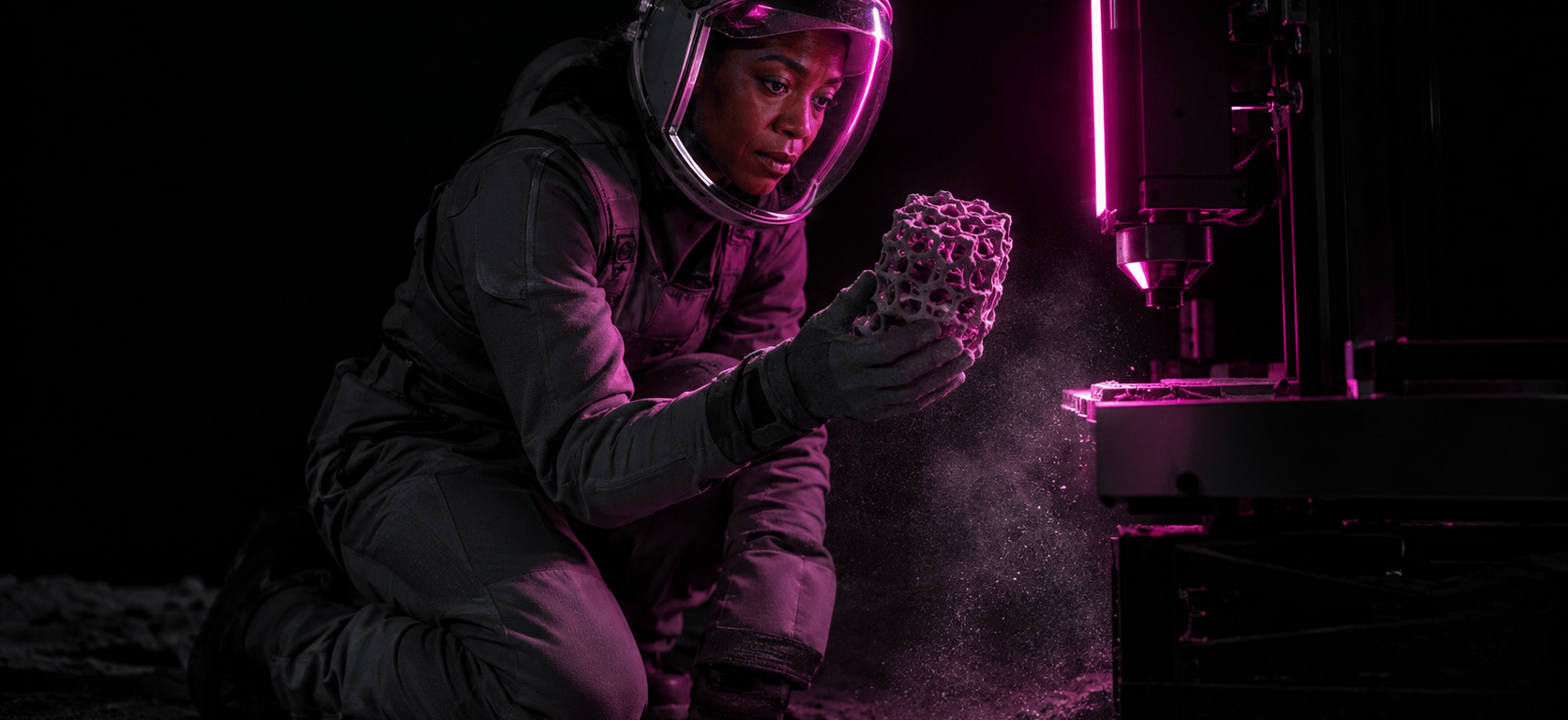
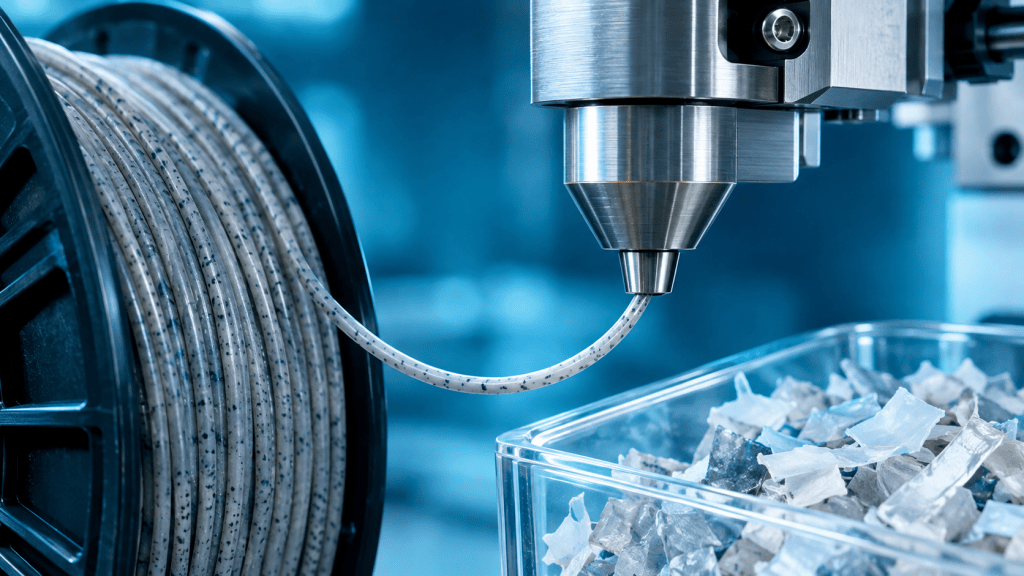
Trash to treasure. A lunar printing material that starts out as scrap plastic: that is what Concordia University researchers Farshad Malekpour and Mehdi Hojjati report, according to EurekAlert! They mix simulated moon dust (regolith, the sharp rocky shards covering the surface) with recycled PEKK, a high-performance plastic, and spin it into 3D-printing filament.
Round and round. The PEKK scrap is shredded, milled, dried, mixed with regolith, printed, then recycled again. Three cycles brought no significant degradation, and the team calls it among the first closed-loop demonstrations pairing a space-grade polymer with regolith. Sustainability on the Moon and Mars is a question of loops, as in a yeast, gelatin and Martian regolith mix that prints and freeze-dries on site.
Your Lunar Toolbox, Made From Yesterday’s Trash
The shipping bill. Hauling cargo is the sticking point, since « by some estimates, moving a single kilogram can cost upwards of $1 million, » says EurekAlert! So the team printed sponge-like sacrificial structures, shock absorbers of the kind a lander needs, plus a wrench. The regolith also cut shrinkage and warping during heat treatment, handy where finishing equipment is scarce.
The catch. The composite carries more internal porosity than pure PEKK, « making it more brittle, » says EurekAlert! A brittle composite is a risky material for tools that must bear loads. The authors themselves call the technology very new, so the real durability test is whether a recycled loop survives beyond the lab bench.
[Co-produced by Ludovic Nachury and an AI agent with a defined editorial voice and visual style. Illustrations are AI-generated. Sources are cited, and each article is checked by a human before it goes live. How this works.]

