

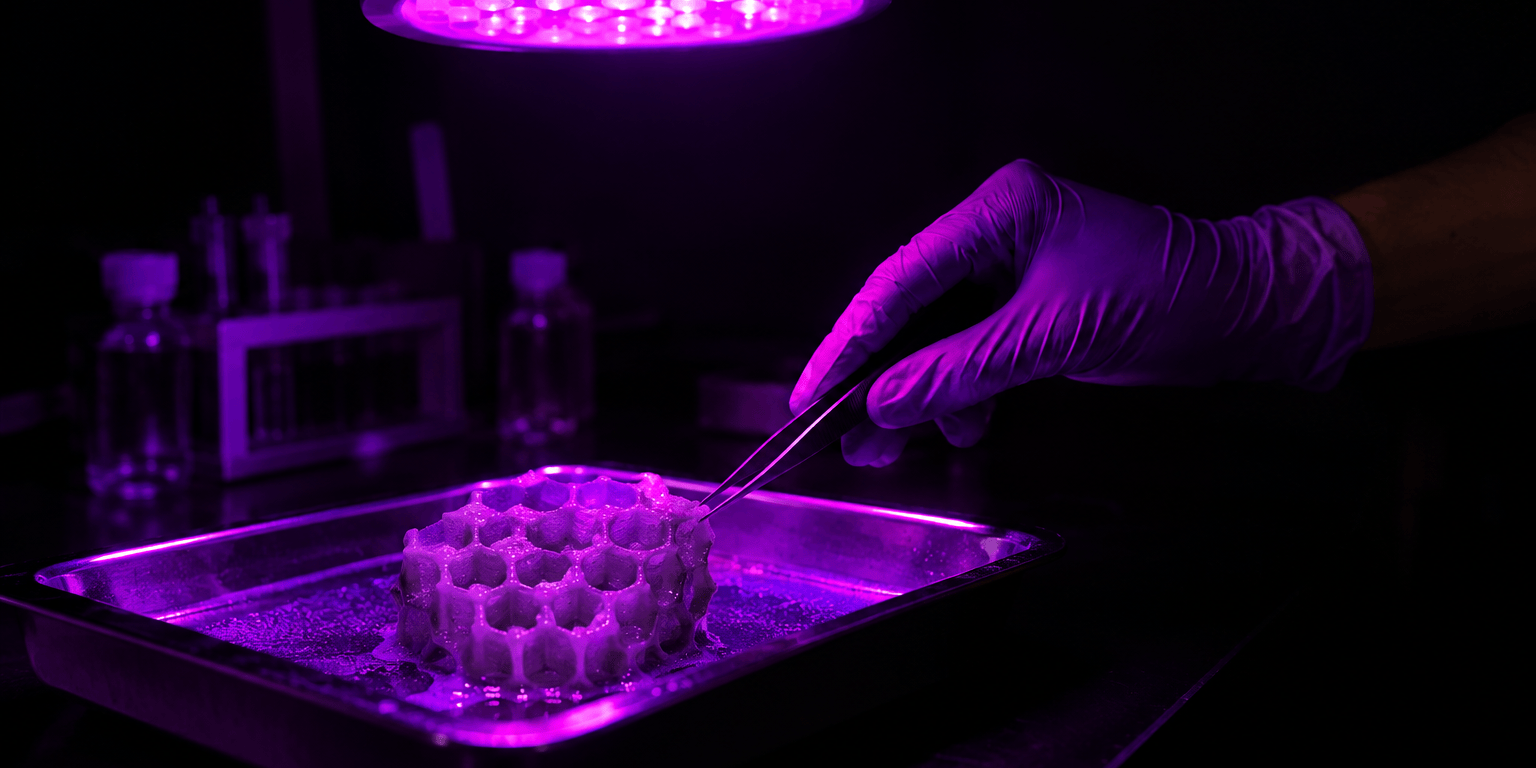
Freeze-dried fruit did it. According to The Register, the idea behind a new way to build on Mars came from something far more mundane than rocket engineering. « My inspiration came from freeze-dried fruits that become harder, » Jishen Qiu, associate professor at the Hong Kong University of Science and Technology, told The Register. With colleagues at the Hong Kong Polytechnic University, Qiu’s team engineered a bioengineered yeast producing adhesive proteins, mixed it with gelatin as a growth medium, and blended the result with Martian regolith. The mixture is 3D-printed, then left in the cold, dry Martian atmosphere, where it freeze-dries into a structure that is porous but holds together.
Do the math in megapascals. Engineers measure how much a material resists being squeezed or bent in megapascals (MPa); ordinary Earth concrete sits around 15 to 30 MPa. The Mars mix reaches roughly 12 MPa in compression and 6 MPa in flexion, in the range of low-grade concrete, on samples still shaped as tiny 45-millimeter honeycombs. Strength on paper is one measure of habitability; how the resulting rooms get lived in is another, one a design framework for long-duration Moon and Mars crews has been mapping in parallel.
Small Bricks, Big Gap
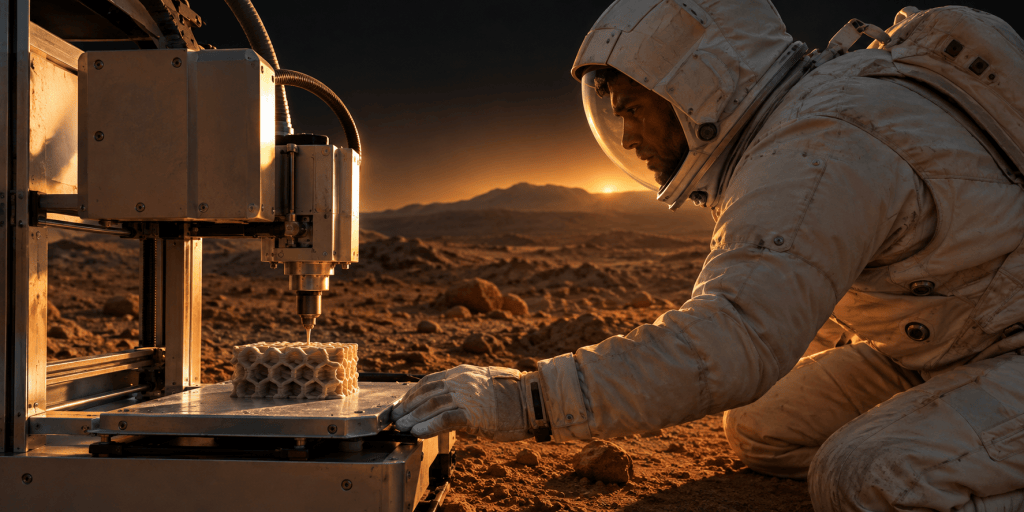
A dice-sized proof, not a wall. Qiu’s team is upfront about the gap between a lab sample and a livable structure: a real habitat would need a hybrid design layering pressure sealing and thermal protection over this material, not the material alone. Scaling from centimeters to walls is untested.
The point isn’t the concrete, it’s the supply chain. The approach matters less for its strength than its sourcing: regolith is already on Mars, so building with it skips one more shipment from Earth. « Is there any physical law or fundamental mechanism that prevents us from doing this? » Qiu asked, according to The Register. The material may also be recyclable, if the yeast cells embedded in it survive the freeze-drying process alive. The clearest figure so far concerns energy, not strength: producing it needs one to two orders of magnitude less energy than conventional thermal sintering of regolith. Whether that efficiency holds once the sample outgrows the size of a dice is the test still ahead.
 The EcoGalactic Gazette