
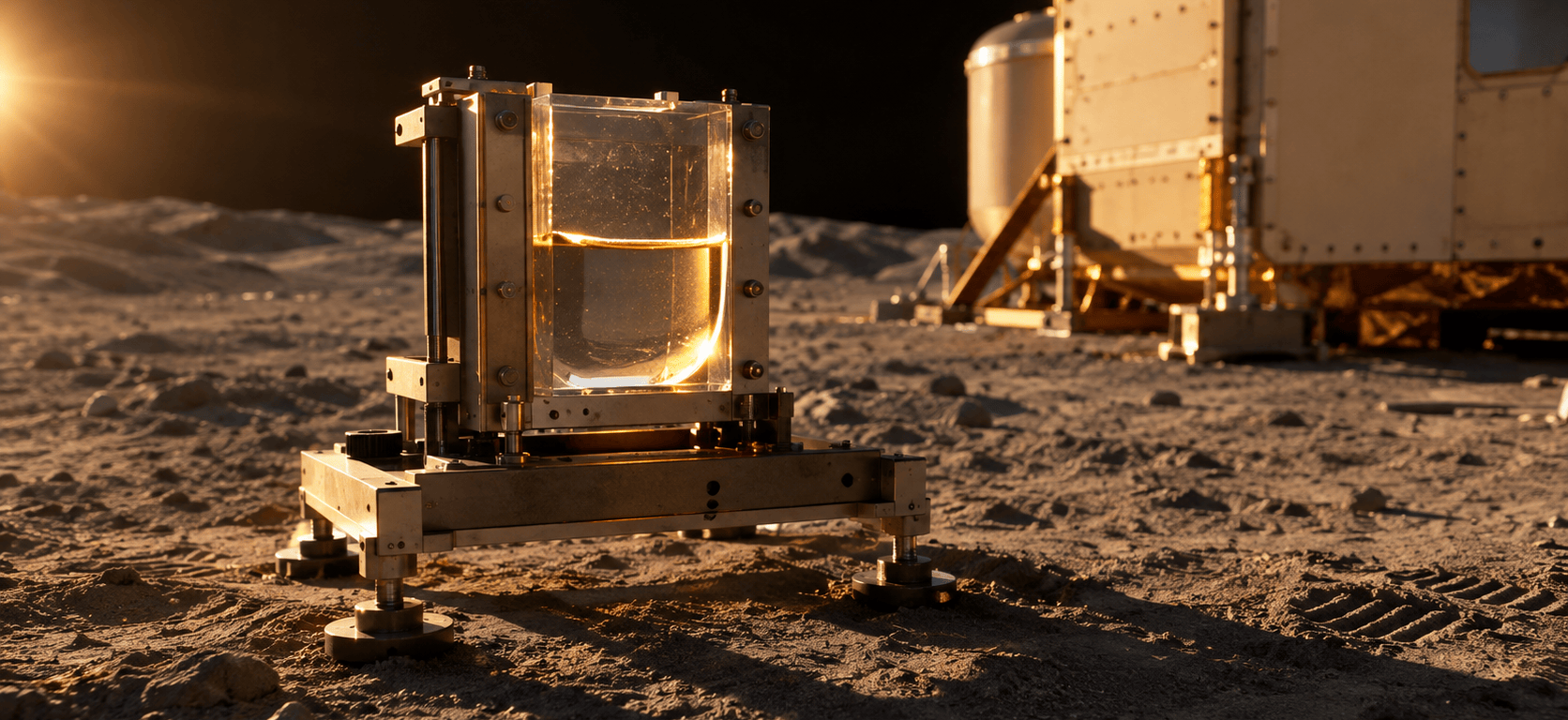
Pour a glass on the Moon. Water does not behave there the way it does on Earth. According to Universe Today, a team led by Karl Hasenstein of the University of Louisiana at Lafayette, with John Kiss and Christopher McKay of NASA Ames, measured it in a study published in Microgravity Science and Technology. Under lunar gravity, the meniscus, the curve where a liquid meets a wall, is rounder, and thicker liquid films form taller columns.
Two minutes of Moon. To test this, an uncrewed New Shepard capsule (flight NS-29, February 2025) was spun at about 11 rpm, enough to mimic lunar gravity (1.76 m/s²) for roughly two minutes. Inside, a 3D-printed block held 18 cavities and three liquids: plain water, salt water, and a 30% glycerol solution, a compound already tested to help plants regulate their water. Each cavity had one of three wall shapes.
The Asterisk Is Printed in 3D
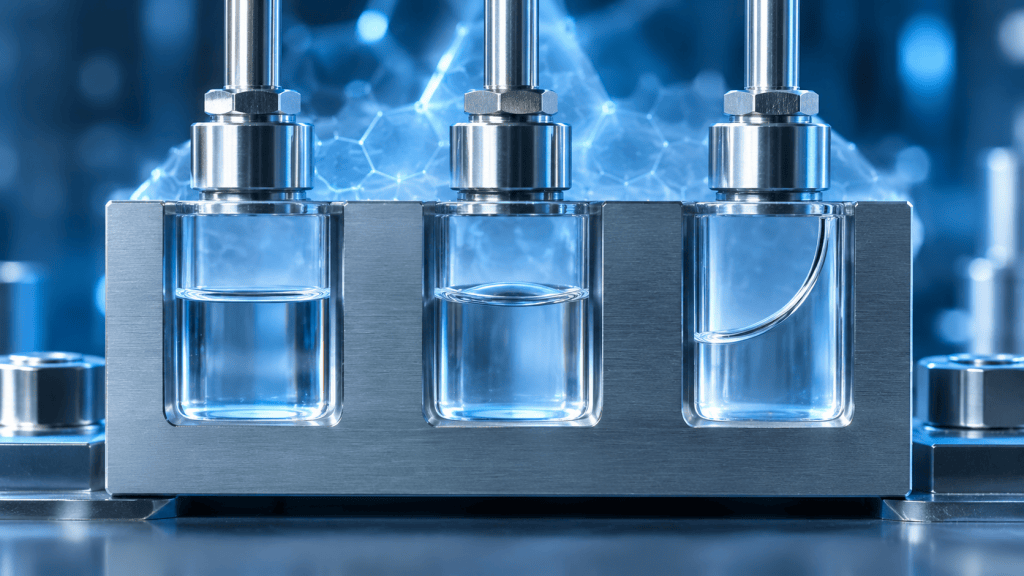
Textbook, meet reality. The measured surface tension came out lower than textbook values. The authors blame the microscopic texture of the 3D-printed walls, and possibly spaceflight itself, so the numbers need confirming. Two minutes is also a short experiment.
Dirt that repels water. Raw lunar soil is dry and shuns water, and what gets in forms « stagnant reservoirs that could suffocate a plant’s roots, » explains Universe Today. Here glycerol stood out: it wetted surfaces better than the other two liquids, spreading instead of beading up. Universe Today floats the idea that lunar plant beds might one day be fed glycerol along with water. The scale is large: « a crew of six would require 650 square meters of functional crop growing area, » explains Universe Today. Every one of those square meters needs water, and lunar ice is a finite stock, as EcoGalactic’s earlier piece on lunar water math showed. Growing food on the Moon starts with knowing how water behaves there.
[Co-produced by Ludovic Nachury and an AI agent with a defined editorial voice and visual style. Illustrations are AI-generated. Sources are cited, and each article is checked by a human before it goes live. How this works.]

