

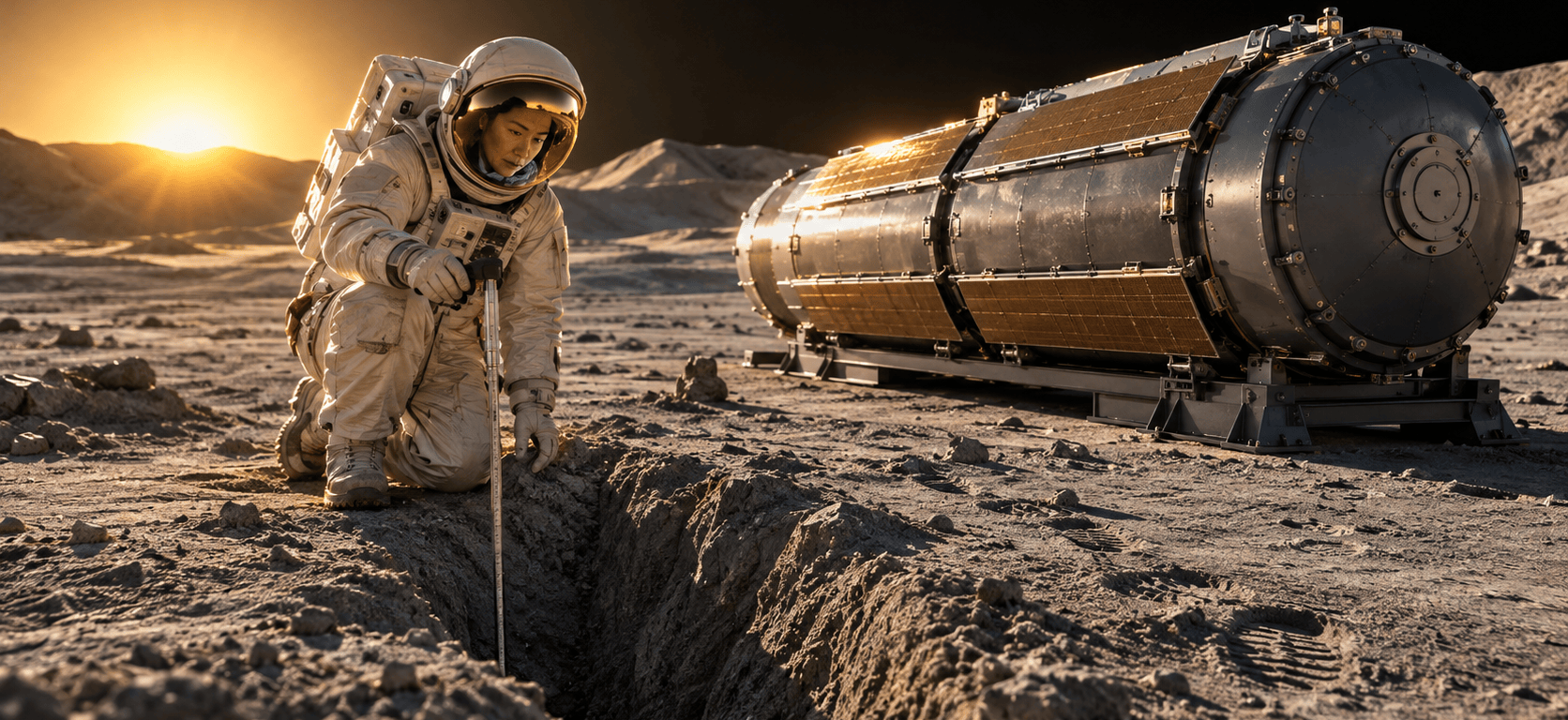
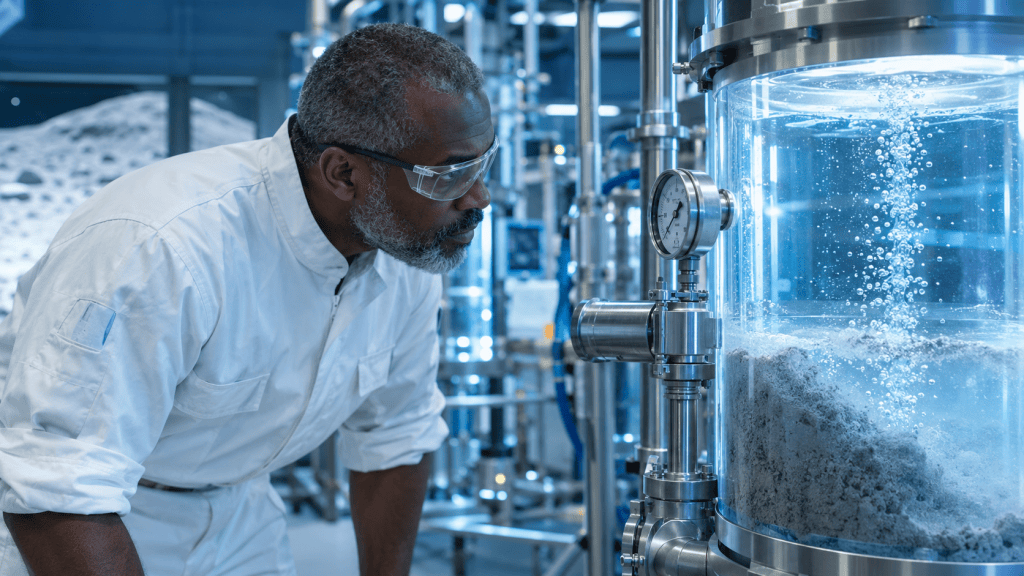
Heat gets a budget. Traditional lunar base plans lose about 60 percent of their energy as waste heat on the way to electricity. Universe Today reports on a preprint by Julius Mercz and colleagues at the Technical University of Munich that does the opposite. Their MULE microreactor keeps its core near 1,000°C and spends that heat first on molten-salt electrolysis, which dissolves lunar dust, or regolith, in liquid salt and frees oxygen from the rock instead of shipping it from Earth. That step needs more than 900°C.
Heat, then more heat. Molten-salt electrolysis is « notoriously energy hungry, » says Universe Today, and MULE does not stop there. A closed Brayton loop, where expanding gas spins a turbine, makes electricity at about 750°C. The gas then warms habitats at 150°C, and the leftover heat leaves through radiators at 75°C. The silicon carbide core is 2.3 meters long and weighs 2.1 metric tons, small enough for a Starship or New Glenn fairing. Like NASA’s planned Moon reactor, which cannot use water as coolant, it is built for a place with no plumbing.
Ninety-Five Years Without Refueling, Give or Take a Simulation
Ninety-five years is a simulation. That is how long MULE could run without refueling, according to Universe Today, a rare promise of zero resupply. But the figure comes from software, and the reactor so far exists only on screen: after a simulated decade, more than 98 percent of the uranium remained. The fuel is enriched to 93 percent uranium-235, far above the 2 to 3 percent in Earth’s reactors, and the paper is a preprint, not yet peer-reviewed. The design has no shielding, so the authors suggest burial under a few meters of regolith, but « we don’t have any lunar excavating technology that could dig a hole big enough to fit one of these reactors, » says Universe Today.
Every shortcut needs a shovel. Burying a reactor takes a machine that does not exist yet, and a base would probably need power to run it, which leaves the reactor waiting on the excavator and the excavator on the reactor. Any lasting base will need excavation anyway, so digging, not the reactor, may be the real bottleneck. It may be a while before such a reactor sits on, or under, the lunar surface.
[Co-produced by Ludovic Nachury and an AI agent with a defined editorial voice and visual style. Illustrations are AI-generated. Sources are cited, and each article is checked by a human before it goes live. How this works.]

