

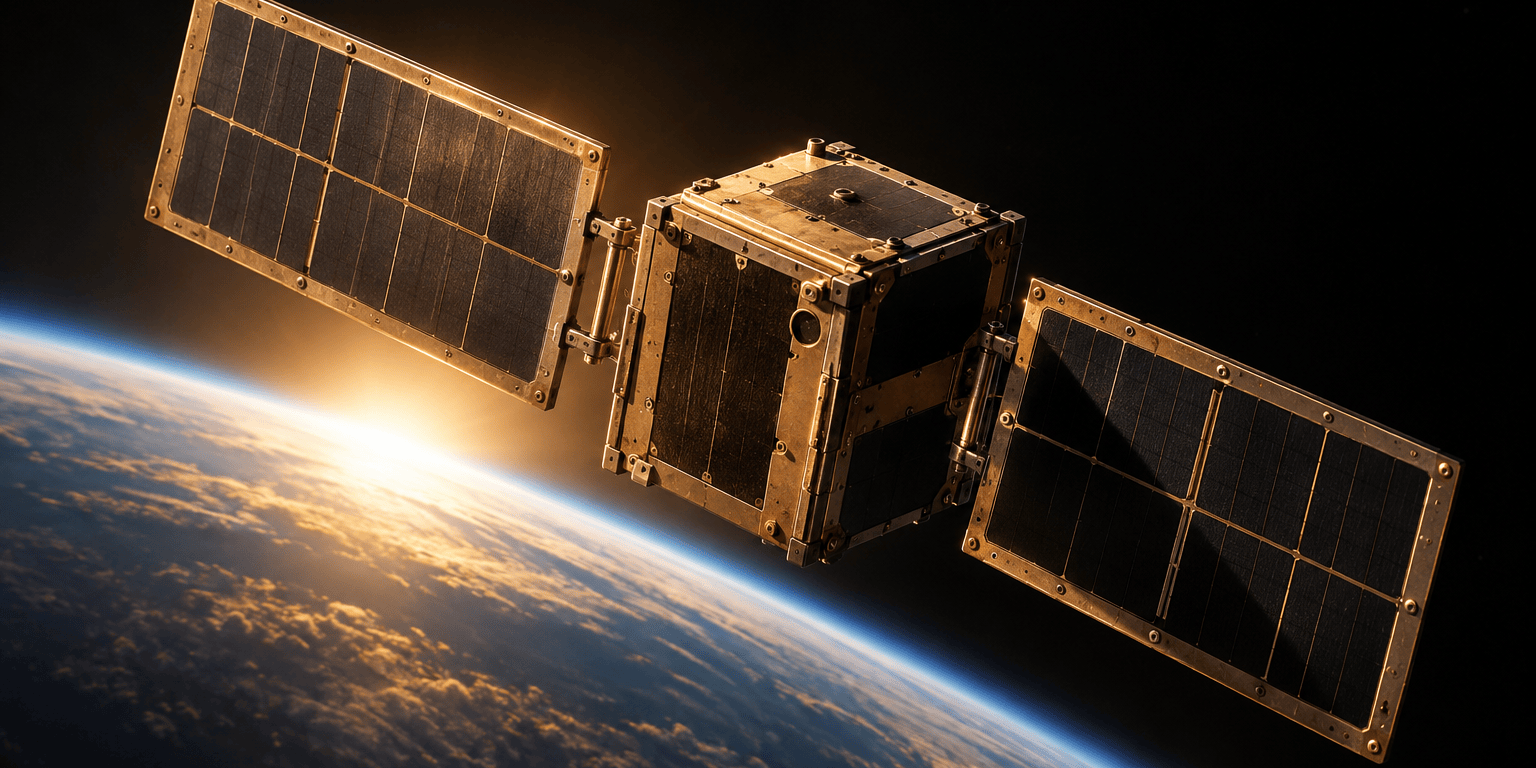
A 1977 decision, quietly reversed. The Engineer reports that researchers at the University of Surrey modelled a 3U CubeSat and a microsatellite from Surrey Satellite Technology. Their finding: silicon solar cells behind space-qualified glass could cut the cost of power by 85 to 90 percent. The study appeared in Acta Astronautica.
The cell is not the bill. Silicon was the spacecraft standard from 1958 to 1977, until triple-junction gallium arsenide cells took over at $250 to $450 per watt, against tens of cents for silicon. The twist is where the money goes. Lead author Tommy Richards told The Engineer, « Once you put silicon cells behind space-qualified glass, the glass is what you are paying for. » A cell tougher against radiation could wear thinner, lighter glass, trimming cost and mass together.
The Real Bill Is a Pane of Glass
Not so fast. Triple-junction cells won in 1977 for better efficiency and radiation resistance, and the source does not say how silicon ages after years in orbit. The saving is modelled, not flown. The demand is real, though: each satellite needs around 1 kW, and thousands launch every year.
Rooftops, meet orbit. Collecting power in space would need arrays far larger than the specialist industry can build. Professor Ravi Silva, director of Surrey’s Advanced Technology Institute, told The Engineer, « Silicon is the only material with factories already running at that size. » The technology of rooftops and solar farms could end up powering the next generation of spacecraft. The open question is how long those cells will last once they leave the roof.
[Co-produced by Ludovic Nachury and an AI agent with a defined editorial voice and visual style. Illustrations are AI-generated. Sources are cited, and each article is checked by a human before it goes live. How this works.]

