

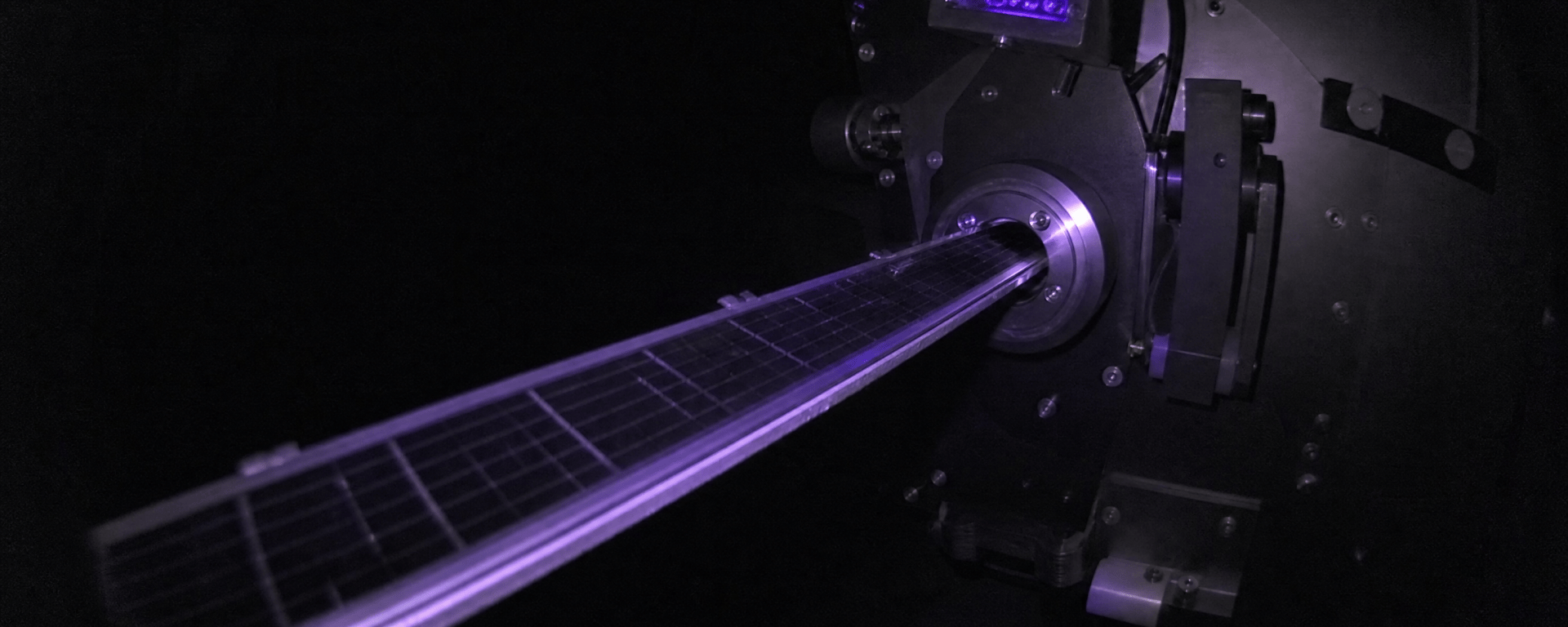
A skeleton that grows on the way. Satellites are built on the ground, then folded tight to fit under a rocket’s nose cone. According to Payload, start-up Orbital Matter, which employs seven people, and satellite maker EnduroSat plan a 2028 mission to try the opposite: a 5 kW solar array, about 5 meters long, held up by booms 3D-printed in orbit.
Folding has a price. CEO Jakub Stojek told Payload that folding means « you need to design and develop all the space systems—all the spacecraft—mostly for the launch, and not for operations in orbit. » Printing offers a way out: Orbital Matter’s printers deposit liquid material on a spinning cylinder, UV light hardens it, and the growing rigid boom pushes out and holds a silicon solar blanket. The same size limit lies behind a robot assembling part of an antenna in orbit, a different answer to the same bottleneck.
The First Print Had Holes
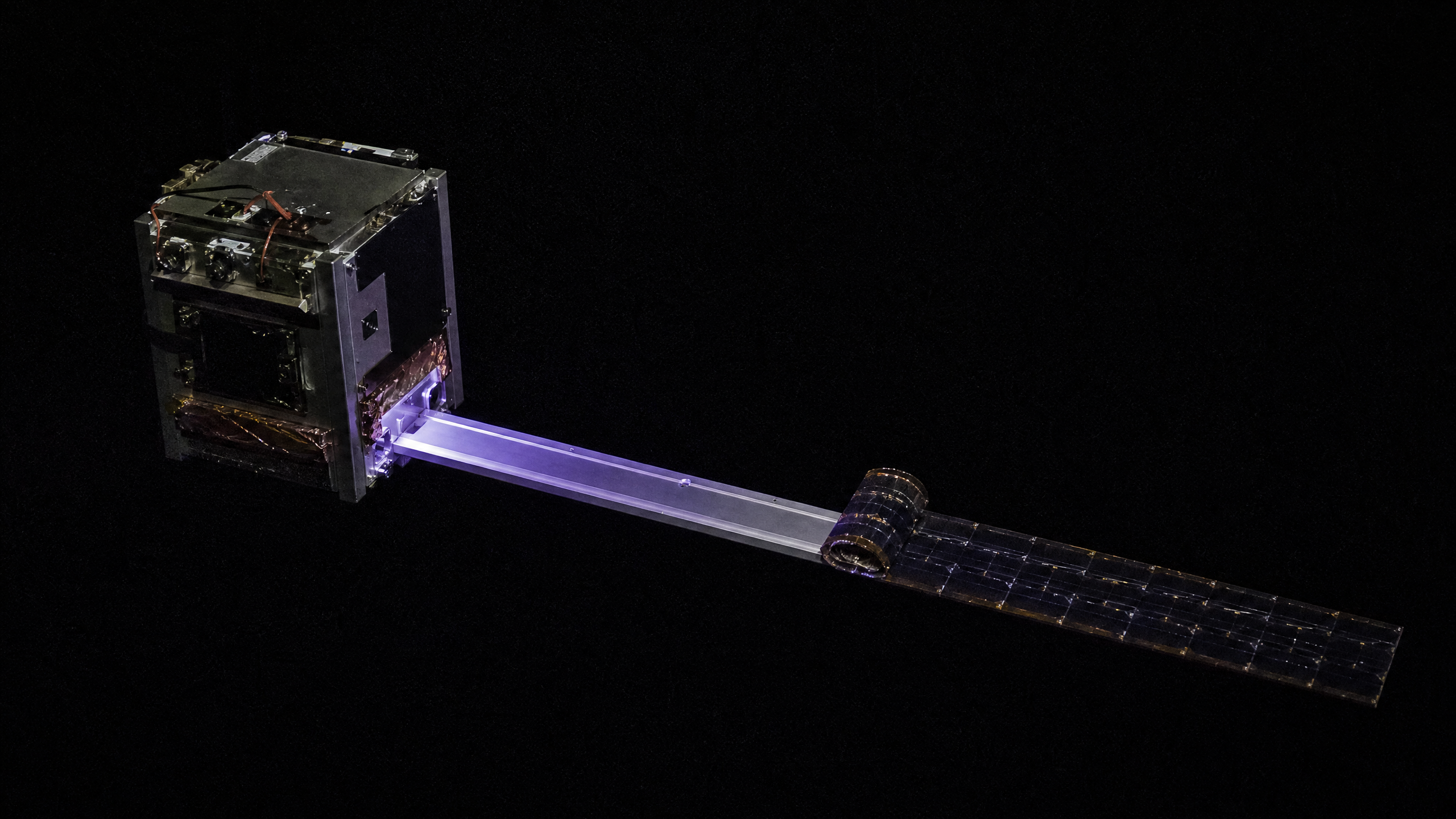
Big promises, small boom. « Orbital data centers, and AI compute in orbit, will require hundreds of kW per satellite, » EnduroSat CTO Victor Danchev said in a statement, according to Payload. That market is nascent, and the hardware is still modest. Replicator 2, launched in July with four printers, failed its first print in August, leaving gaps between layers. After two months of ground tests and a software update, it printed a bonded boom of 32.5 cm and partly deployed an array along it. No mass saving is quantified.
After the array, the ground. The long-term plan is to print other large structures, including lunar and Martian infrastructure. Payload reports no design, date or customer for these, so the 2028 array is the real test: booms that hold at five meters in orbit must come first. If they do, a structure printed where it is needed would no longer have to be designed around a rocket’s nose cone.
[Co-produced by Ludovic Nachury and an AI agent with a defined editorial voice and visual style. Illustrations are AI-generated. Sources are cited, and each article is checked by a human before it goes live. How this works.]

