
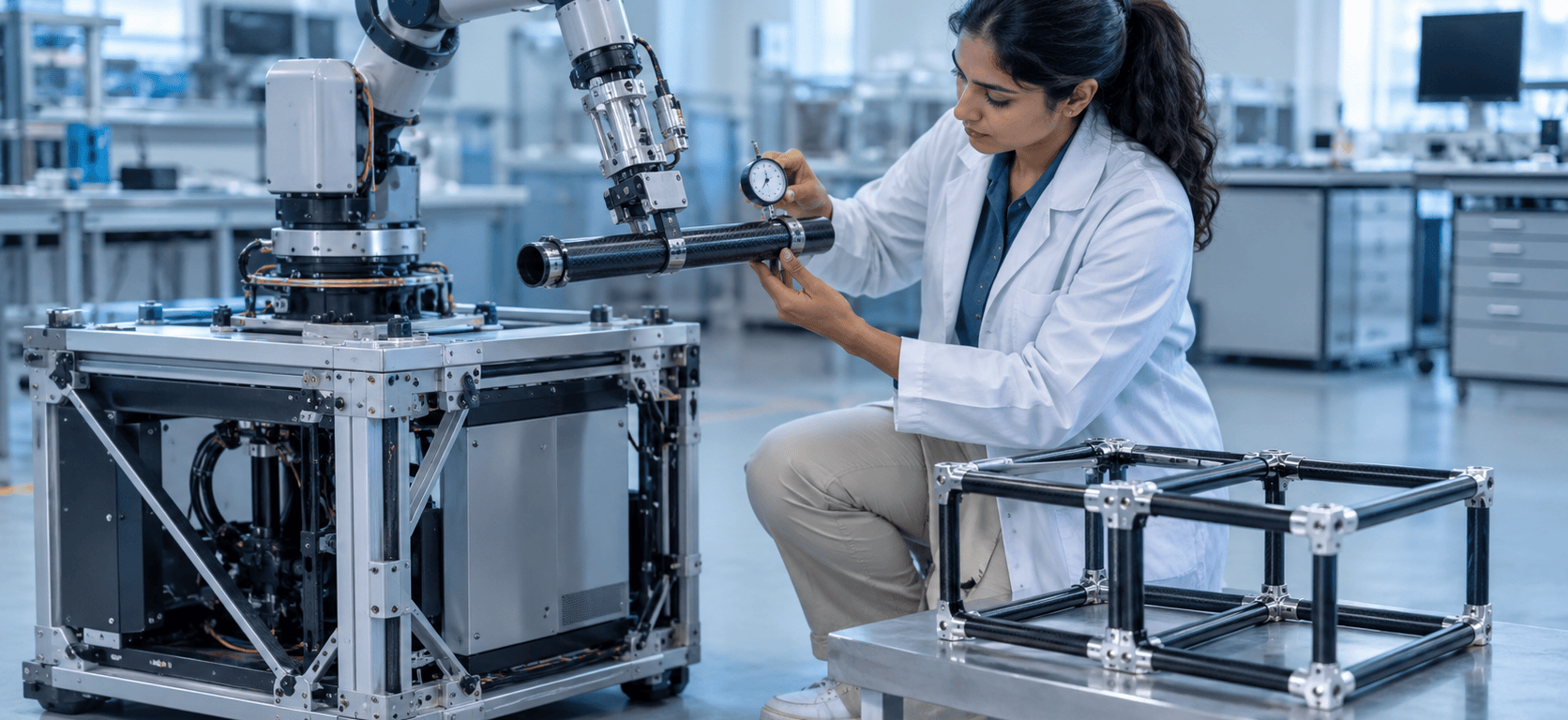
A robot picks up the tools. Building in orbit is usually work for astronauts on spacewalks; this time a robot did part of it alone. According to ScienceDaily, relaying a Caltech release, ASTRA, a machine of about one cubic meter launched on 30 March 2026 aboard Momentus’ Vigoride 7 (SpaceX Transporter-16), carried out the first autonomous construction of a structure in space. « This is the first time that a structure has been autonomously constructed in space, » said Sergio Pellegrino, who leads the project, in the release.
One bay out of eleven. The goal is a 1.4 m reflector antenna made of 11 bays. Two came pre-assembled and were unfolded; the robot built a third. The antenna will not be finished before the mission ends in December. Ground contact allows only 7 to 8 windows a day of about 15 minutes, and faults are reproduced on a twin kept at Caltech to test fixes. « Developing a payload of this complexity on such a short timeline was an enormous undertaking for our small team, » Pellegrino said in the same release.
Why Not Just Fold It?
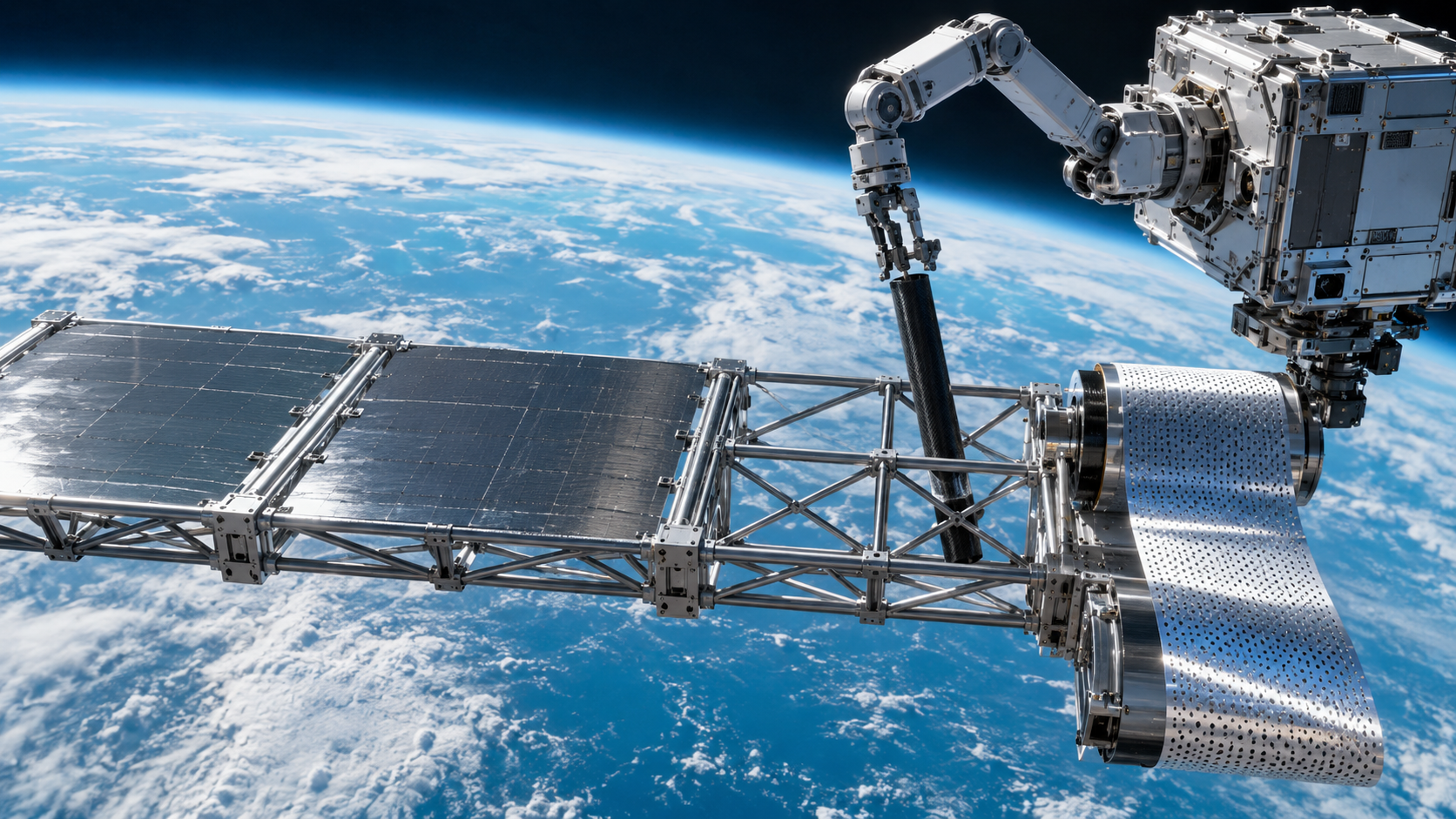
Too big for the box. Beyond a certain size, structures can no longer be built on the ground and unfolded in orbit, hence the case for assembling them in space. DARPA’s NOM4D program, launched in 2022, retained ASTRA as one of two phase-3 projects; the other hardens carbon tubes aboard the ISS. Orbital infrastructure is taking shape elsewhere too: one company plans a first light-beam power transfer between two spacecraft, the first step of an orbital power network.
Lighter, maybe. The antenna’s perforated film, developed with the University of Pennsylvania, needs less tension than knitted metal mesh, so the supporting structure can shrink and the whole could get lighter, since every kilogram weighs on the launcher. No weight figure is given, and the release does not say what becomes of the unbuilt bays after December. The team still judges the approach feasible; how much lighter it gets, and at what scale, stays open.
[Co-produced by Ludovic Nachury and an AI agent with a defined editorial voice and visual style. Illustrations are AI-generated. Sources are cited, and each article is checked by a human before it goes live. How this works.]

