
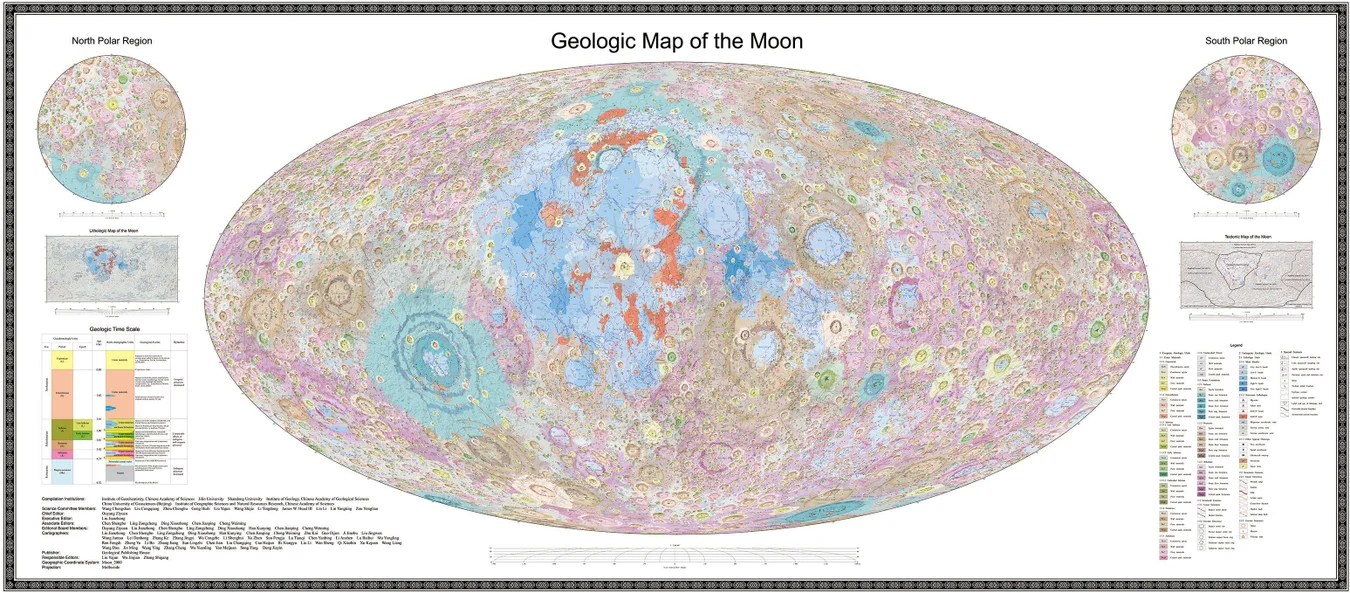
China’s release of the highest-resolution geological Moon maps to date marks a significant milestone in lunar exploration, explained Scientific American. The Geologic Atlas of the Lunar Globe, a product of over a decade of research involving more than 100 scientists, offers unprecedented insights into the Moon’s surface features, including 12,341 craters, 81 basins, and 17 rock types.
Out with the Old, In with the New
Geological maps play a crucial role in understanding the Moon’s surface. Ross Mitchell, a geophysicist at the Chinese Academy of Sciences (CAS) Institute of Geology and Geophysics in Beijing, emphasized to Scientific American that « every question in geology starts with looking at a geological map. » Previous lunar maps, dating back to the 1960s and 1970s, have become outdated and unable to meet the needs of modern lunar research and exploration. The new atlas addresses these shortcomings by providing a comprehensive and detailed view of the Moon’s geological features.
Mapping the Moon: A Global Group Effort
The creation of the atlas was a collaborative effort, drawing on data from China’s lunar exploration program, particularly the Chang’e-1 mission, as well as international missions such as NASA’s Gravity Recovery and Interior Laboratory (GRAIL) and Lunar Reconnaissance Orbiter, and India’s Chandrayaan-1 probe. Observations made by the Chang’e-3 and Chang’e-4 lander missions verified the accuracy of the Chang’e-1 data. However, mapping the Moon’s far side remains a challenge due to communication difficulties, serving as a reminder of the obstacles still to be overcome in lunar exploration.
A Bright Future for Lunar Exploration
The new lunar atlas holds immense potential for future research and collaboration. Scientists will be able to better understand the history of the Moon, evaluate potential lunar resources, and conduct comparative geological studies. Furthermore, the atlas will inform the location choices of future missions, including the establishment of a lunar research base. As part of an international collaboration led by China and involving Russia and over a dozen other countries, the International Lunar Research Station aims to take shape at the Moon’s south pole in the mid-2030s.
This groundbreaking lunar atlas not only paves the way for exciting advancements in lunar research and exploration but also underscores the importance of international collaboration in unlocking the mysteries of our celestial neighbor.