

In the quest to establish a sustainable human presence in space, understanding fundamental processes like boiling liquids in reduced gravity environments is crucial. The Southwest Research Institute (SwRI) is tackling this challenge head-on with an innovative study that could pave the way for more efficient and eco-friendly thermal management systems for future space missions and settlements.
A Splashing Good Time!
SwRI’s groundbreaking project involves conducting experiments on parabolic flights to observe how liquids boil on various engineered surfaces in simulated lunar and Martian gravity. By using a specialized fluid that boils at just 135°F (57°C), researchers can examine bubble formation, growth, and detachment on four heated surfaces with distinct roughness levels and material structures.
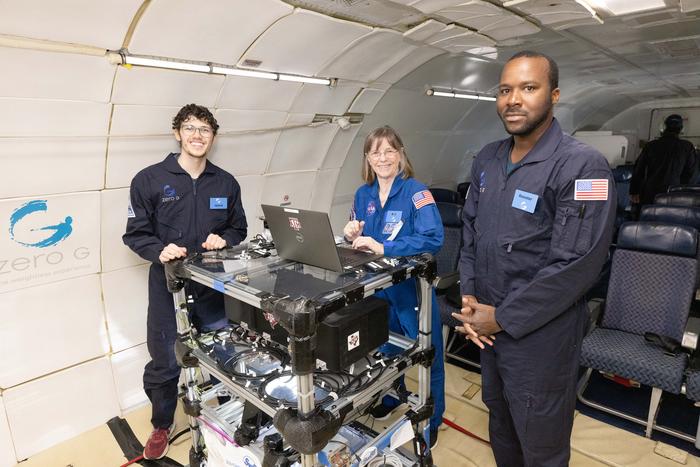
« We have so little data about how boiling works in reduced gravity, » explains Kevin Supak, the project lead at SwRI. This lack of understanding is a significant obstacle in designing effective thermal management systems for extraterrestrial environments.
Gravity’s A Beach!
Replicating the intricate dynamics of boiling in partial gravity is no easy feat on Earth. The complex interplay between buoyancy forces, surface tension, and other factors governing boiling behavior is heavily influenced by gravity. SwRI’s parabolic flight approach offers a unique opportunity to study these processes under more realistic conditions.
« When you’re boiling water on the stove, you’ll notice different bubble sizes and behavior between a stainless pot and a nonstick pot, » Supak notes. This observation highlights the importance of surface characteristics in boiling processes – a critical consideration for SwRI’s research.
By testing engineered surfaces with varying material properties and structures, the team aims to identify designs that optimize bubble formation, detachment, and overall heat transfer efficiency in partial gravity environments.
Life, But Not As We Know It
While alternative methods like computational modeling and ground-based experiments offer insights, they often struggle to capture the nuances of boiling behavior in partial gravity over extended periods. SwRI’s approach holds the potential to revolutionize thermal management solutions for future space missions and long-term settlements.
Efficient heat transfer processes, such as the boiling phenomenon studied by SwRI, are essential for enabling a sustainable human presence on extraterrestrial bodies. These processes are crucial for maintaining life support systems, generating power, and utilizing resources in space habitats. As Kevin Supak emphasizes, « If we’re going to establish a sustained presence in space or on other worlds, boiling is a necessity. »
A Small Step Towards Leaving No Trace
The significance of SwRI’s research extends far beyond technological advancement. By enabling more sustainable and efficient thermal management systems, this study brings us closer to realizing the dream of thriving, environmentally conscious extraterrestrial settlements.