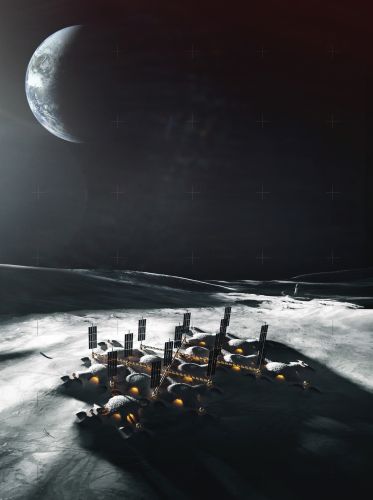
Humanity stands at the precipice of a new era, poised to extend its footprint beyond the confines of Earth and establish thriving communities on the lunar surface. A collaborative endeavor between design pioneers and space exploration experts, described by Building Design, has given rise to a groundbreaking 3D-printed lunar habitat model, soon to grace the Royal Academy of Arts’ Summer Exhibition.
This scalable settlement, envisioned by Hassell in partnership with the European Space Agency (ESA), could sustainably accommodate up to 144 people, ushering in a future once relegated to the realms of science fiction.
Sand Castles on the Moon?
What sets this lunar habitat concept apart is its innovative approach to construction and sustainable growth. The design features interlocking hexapod-shaped components made from 3D-printed sand, offering flexibility and crucial radiation shielding. « Shaped by loosely connected hexapod-shaped components made from 3D-printed sand and interlocked, it offers a different approach to the monolithic structures previously proposed for lunar settlement, » explains Building Design.
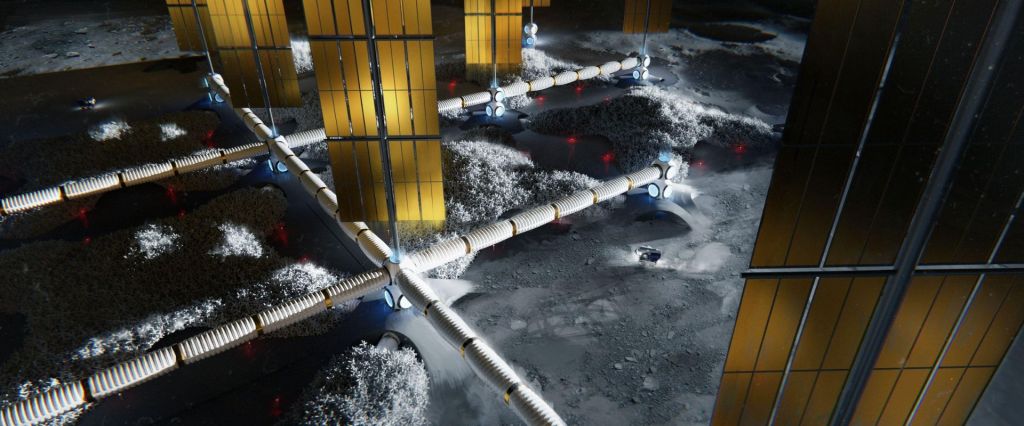
Remarkably, the in-situ construction process harnesses lunar soil and 3D printing technology directly on the Moon’s surface, paving the way for expansion over time. This stands in stark contrast to traditional one-piece lunar settlement proposals, which, according to Building Design, lack the adaptability and resource efficiency of Hassell’s modular design.
Home Away from Home?
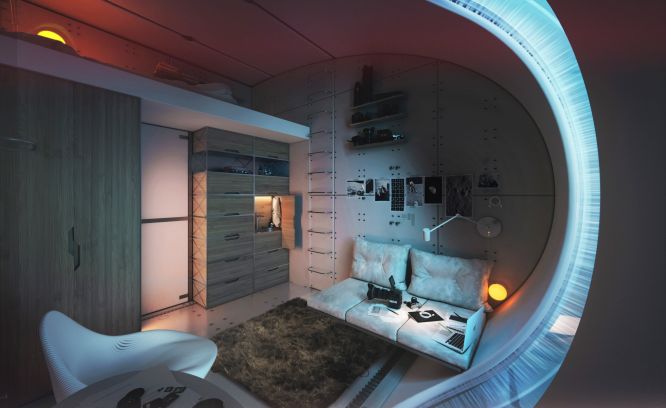
Beyond its technological marvels, the Lunar Habitat Master Plan prioritizes the human element, ensuring future settlers not only survive but thrive in their extraterrestrial abode. Through a collaborative effort involving anthropologists, psychologists, roboticists, and astronauts, the habitat aims to create a livable and prosperous environment. Recreational, active, and enriching earth-based settings are integrated to support the well-being of the lunar community.
Lunar Resort & Spa?
Significantly, this lunar habitat could facilitate the critical work of space agencies and companies. As Xavier De Kestelier, Hassell’s global head of design and innovation, declared to Building Design: « The Moon is an extremely hostile place to live. With no atmosphere, humans need novel infrastructure to access water and oxygen while subjected to high radiation. We need to start planning for how larger communities can not just survive but thrive and live on the moon. »
As humanity sets its sights on the celestial frontier, it is evident that sustainable space exploration requires a delicate balance between technological innovation and environmental stewardship. « By providing 3D-printing technology utilizing lunar soil, we set the way forward for the habitat’s sustainable growth for decades to come, » De Kestelier emphasized.