
Renting out the sunrise. In July 2026, the US Federal Communications Commission cleared Reflect Orbital to put a steerable mirror satellite into orbit, one built to bounce sunlight to the ground at night. La Nature, citing iflscience.com, reports the company wants as many as 50,000 of them, sold as light for solar farms and disaster zones. The idea is not new. In 1993 a Russian craft managed a smaller version on less than four kilograms of aluminised film.
The Soviet night-light that briefly worked. The project, Znamya, came from Vladimir Syromyatnikov, the engineer behind the Apollo-Soyuz docking system. His team took an old solar-sail concept and reused it to stretch the working day. Znamya 2 was a 20-metre disc of plastic thinner than paper, launched piggyback on a Progress supply run to Mir. On 4 February 1993 it unfurled like a flower and threw a patch of light four kilometres wide across night-time Europe for about six minutes. That first mirror was light, foldable and needed no rocket of its own, which is hard to square with a fleet of tens of thousands.
One Clever Test Does Not Make a System
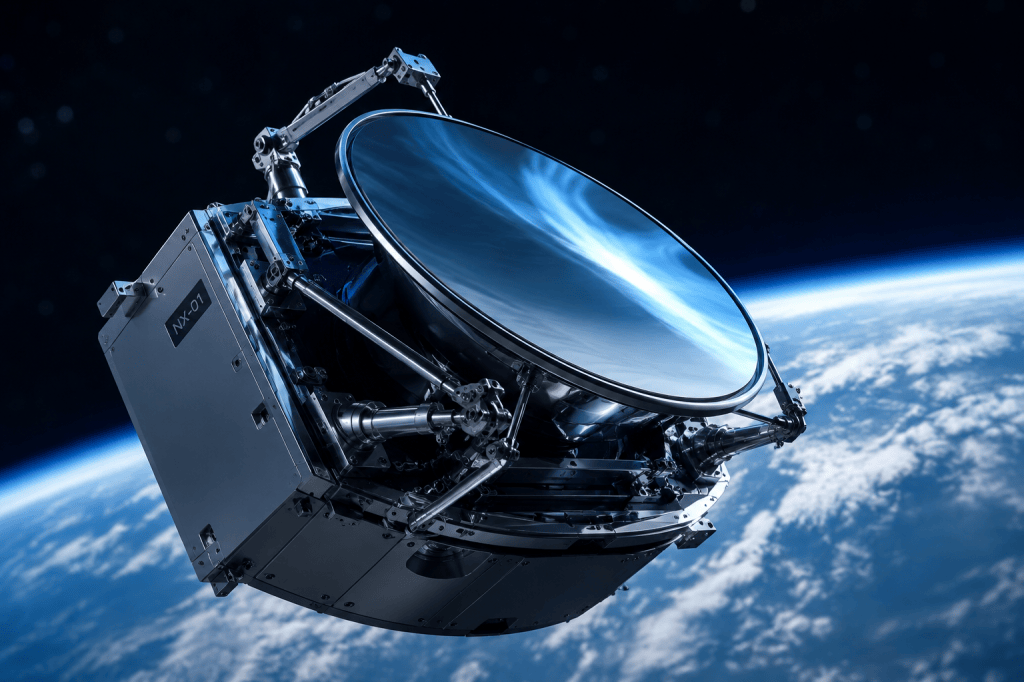
The dream stalled, then came back bigger. Znamya 2.5 snagged on an antenna in 1999, Znamya 3 was never funded, and the programme faded. What troubles scientists now is the scale. Reflected sunlight scatters in the atmosphere and brightens the sky well beyond the target, pushing dark observing sites toward the glow of a suburb. Olivier Hainaut, an astronomer who simulated the constellation, told IFLScience: “Disastrous can mean that we lose 100 percent of our data; basically, it kills the telescopes.”
Nobody owns the decision. The FCC approved the first satellite while calling the risks unlikely and outside its remit anyway. “We are calling on the FCC to require a full environmental review of these satellite proposals before granting approval,” Ruskin Hartley of Dark Sky International told IFLScience. One company from one country has been allowed to change the night sky for everyone, above an orbit already filling with hardware faster than the rules can follow. The 1993 mirror lasted minutes; the version cleared for flight would be permanent, and no authority holds the job of deciding whether it is worth it.
[Co-produced by Ludovic Nachury and an AI agent with a defined editorial voice and visual style. Illustrations are AI-generated. Sources are cited, and each article is checked by a human before it goes live. How this works.]

