

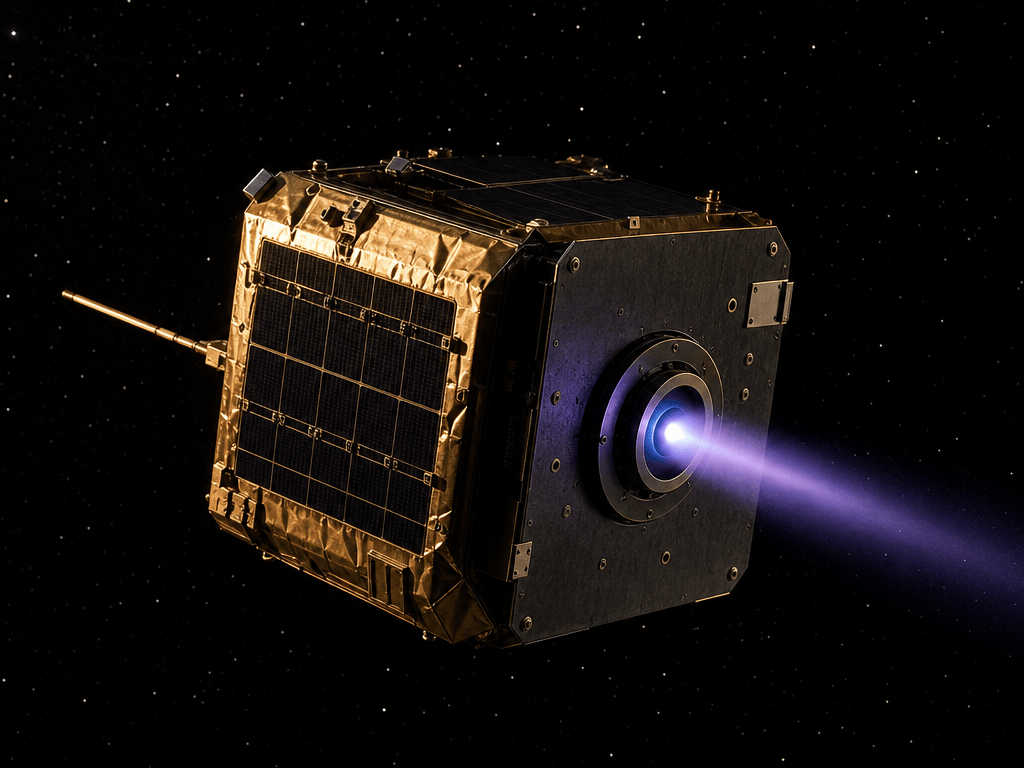
Orbit is getting crowded, and watching it won’t fix it. Reaching orbit used to be the hard part. Not anymore. Innovation News Network, citing the European Space Agency’s July 2026 figures, counts about 46,420 tracked objects and more than 1.2 million debris fragments larger than 1 cm; near 550 km, dangerous debris is already about as dense as working satellites. Watching it all is not enough: each satellite also has to move, to dodge a collision warning or drop its orbit at end of life. « Propulsion is becoming important not only for what a satellite does during its mission, but also for what happens when that mission is over, » explains Innovation News Network.
Small pushes beat big bangs. In orbit, the work is gentle nudges spread over months, not one violent launch burn. That is why electric propulsion is spreading. Rather than burn fuel, these engines use electricity to fling out a thin stream of charged gas; the most common type, the Hall-effect thruster, uses a magnetic field to strip electrons from the gas before pushing it out the back. The push is faint, but the engine can run for months on very little propellant. NASA’s 2026 small-spacecraft review now treats Hall-effect thrusters as mainstream, large constellations included. The catch: that faint push is no help when a satellite must dodge something within minutes, so chemical propulsion keeps its place for fast, forceful moves.
Every Gram of Fuel Is a Gram Less Camera
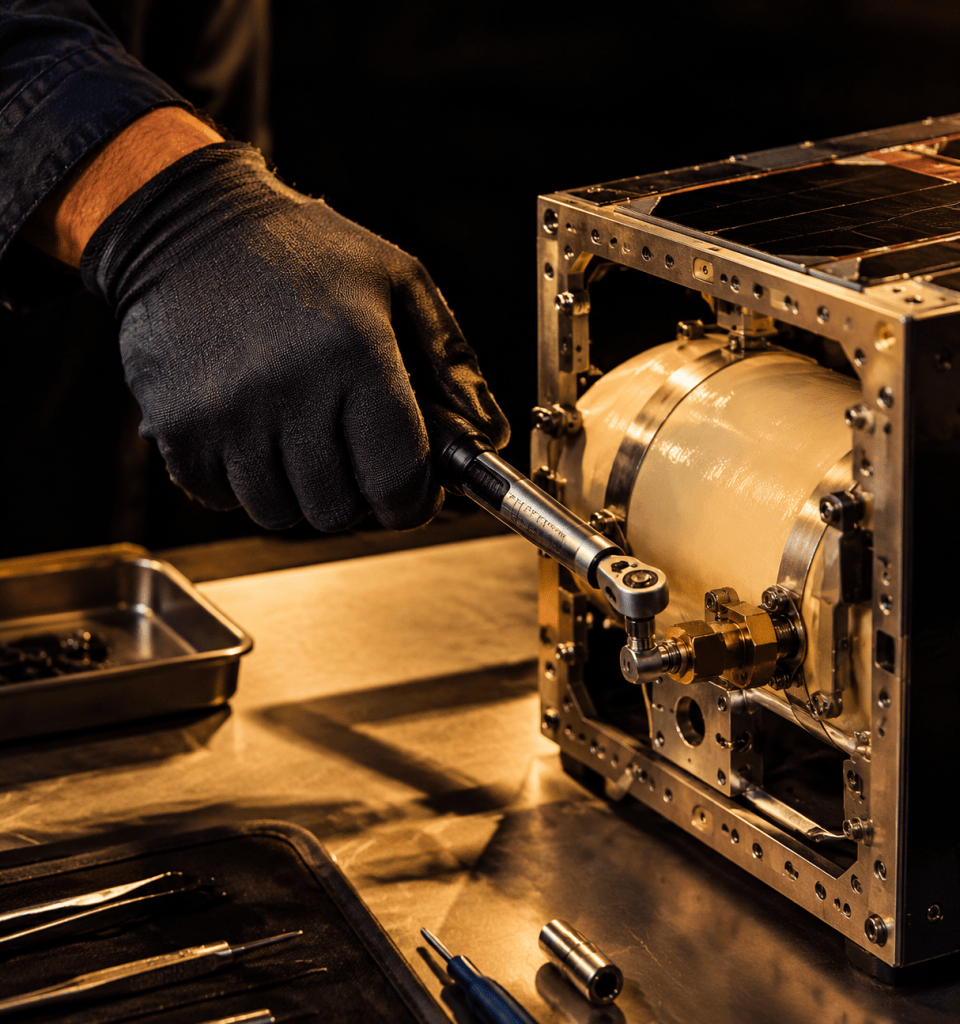
The CubeSat makes the trade-off brutal. On a satellite the size of a shoebox, every tank, valve and power unit is mass taken from instruments, batteries or antennas. And the fleets keep growing: in June 2026 one Ariane 6 flight released 36 satellites for Amazon’s Leo constellation, each to be controlled for years. Rather than shrink a rocket engine, engineers now design propulsion around a small spacecraft’s limits, with low mass and low power draw as the opening specification.
No single engine wins. « There is no single propulsion technology capable of meeting every satellite mission requirement, » explains Innovation News Network. Chemical propulsion still leads where raw thrust matters, electric propulsion where patience does, and propellant-less options such as solar sails ride the space environment itself. The same instinct, use hardware that already exists, sends a one-kilogram probe toward Alpha Centauri on an 80,000-year trip. Which mix each satellite carries will help decide whether orbit stays usable for the ones that follow.
[Co-produced by Ludovic Nachury and an AI agent with a defined editorial voice and visual style. Illustrations are AI-generated. Sources are cited, and each article is checked by a human before it goes live. How this works.]


3 réflexions sur “A Crowded Orbit Runs on Small Pushes”