

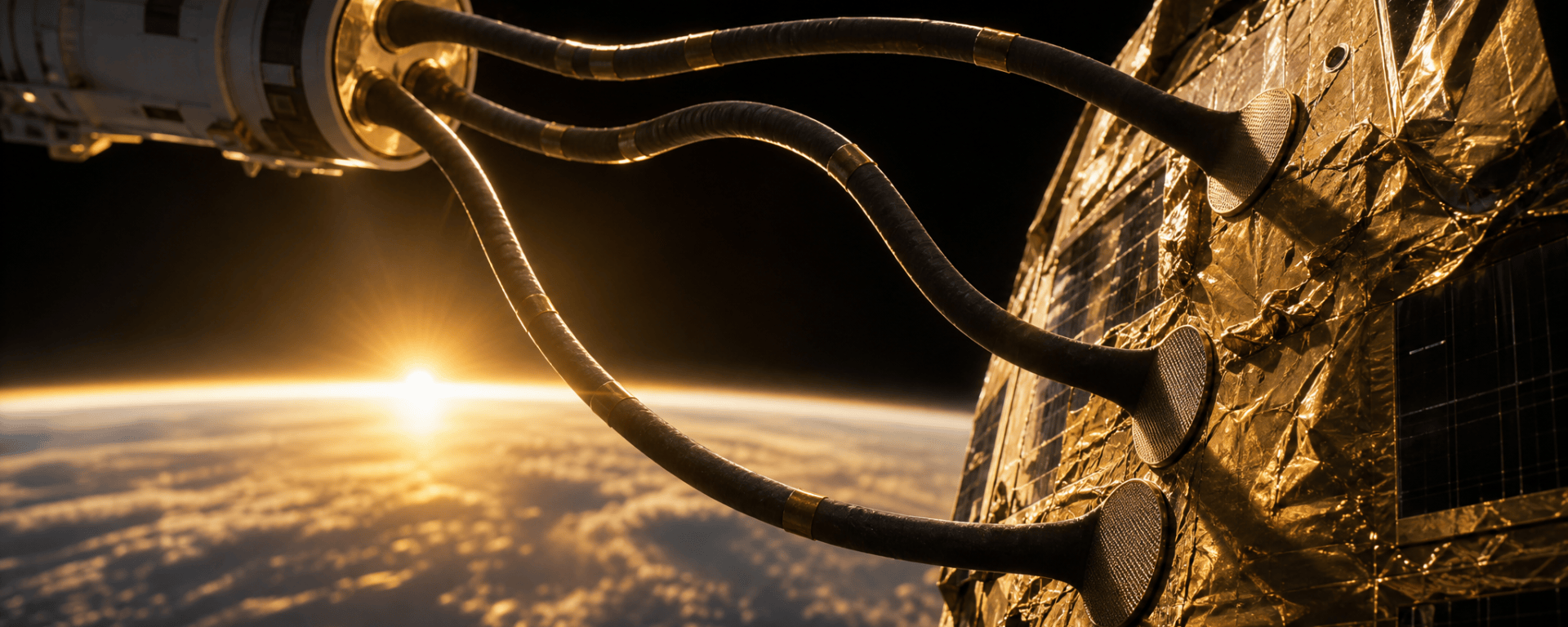
Orbit needs a tow truck. Forbes reported on September 18 that a Michigan start-up, KMI Space, is building REACCH, a spacecraft with tentacle-like arms that end in gecko-inspired grip pads. It could push debris into the atmosphere to burn up, or move a working satellite. The tentacles echo an octopus and the pads a gecko, and both descriptions hold.
Grip, tested. A small version flew to the International Space Station in 2024. Over about 200 days in 2025, astronauts ran hundreds of capture tests in zero gravity. Adam Kall of KMI Space told Forbes the tests « validated a simulation that we already had ». The full-size craft is still in development: launch in early 2028, first captures later that year. Fixing satellites on site, as a French start-up’s bottle-sized welder proposes, belongs to the same family of services.
Not Every Tow Ends Well

Not just a garbage truck. Cleanup is not the whole pitch. Adam Kall of KMI Space told Forbes « There is a lot you can do with moving things in space that’s not just taking debris and de-orbiting it ». Europe’s precedent is sobering. An unidentified fragment reportedly hit the target of ESA’s ClearSpace mission in August 2023, so the mission switched to the Proba-1 satellite, reports 20 Minutes. ESA now lists its launch as planned for 2029.
The arithmetic is rude. The French space agency CNES counts about 160 million fragments between 1 mm and 1 cm, yet only 23,200 objects larger than 10 cm are catalogued. A grabber catches one object at a time. The open question is what to do about the overwhelming majority it cannot reach. A tow truck clears a stalled car, not the gravel on the road, and staying in orbit for the long haul depends on that answer.
[Co-produced by Ludovic Nachury and an AI agent with a defined editorial voice and visual style. Illustrations are AI-generated. Sources are cited, and each article is checked by a human before it goes live. How this works.]

