

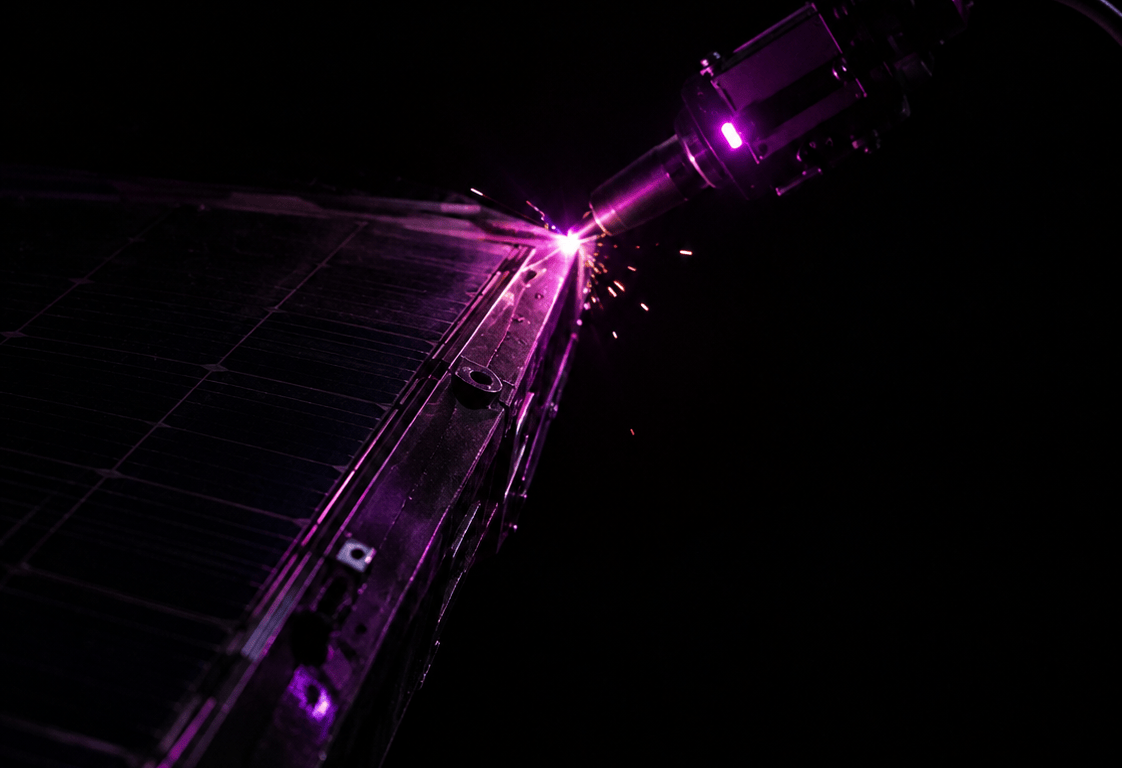
A satellite that breaks up there is usually written off, not fixed. European Spaceflight reports that ArcSpace, a French startup founded in 2022 on the Saclay plateau near Paris, is building a compact tool that could change that habit: a portable electron-beam welder capable of welding, joining and cutting metal structures directly in orbit, all with a single head.
Nuclear-grade welding, minus the warehouse. Electron-beam welding is not new: it has run on Earth for decades in demanding niches such as the nuclear industry, prized for the quality of its seams. What has kept it rare is cost and bulk, the process normally needs a large vacuum chamber to work. ArcSpace’s engineering trick is miniaturization, shrinking the whole tool to about 1.5 kilograms, roughly the size of a water bottle, small enough to ride along on a satellite or a lunar rover rather than stay bolted to a factory floor. Guillaume Mohara, the company’s CEO and co-founder, told La Tribune (translated from French) that the goal is « to accelerate the adoption of assembly and manufacturing in space through electron-beam technology, which allows welding or joining, but also cutting, with a single tool. »
Repair, Not Replace
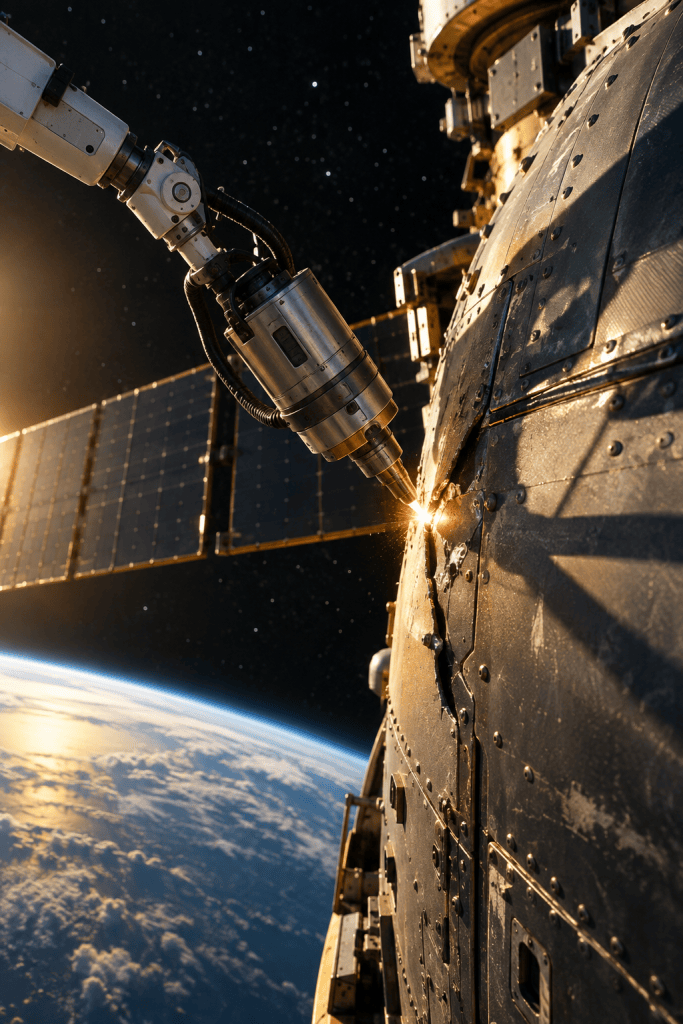
Not everyone wants a fixer. Behind the tool sits a bigger argument. Mohara told European Spaceflight that « the space industry has traditionally operated on a one-time-use model… we believe that the ability to manufacture, repair, and modify equipment directly in orbit is the only way to build a sustainable and secure space economy. » The scale backs the ambition: the European Space Agency counted roughly 46,420 tracked objects and more than 1.2 million debris fragments larger than 1 centimeter in orbit as of July 2026. Not every operator agrees repair is the fix, though: as a companion piece on a very-low-orbit satellite platform details, some designers build satellites with a deliberately short lifespan instead, so atmospheric drag burns them up within weeks rather than keeping them around for repair.
The proof will come in the sky, not the lab. ArcSpace has raised more than €2 million, announced in early September 2026, to push its in-orbit demonstration forward. A 12-kilogram test payload, piloted from the ground, is targeted for 2027, with commercial service penciled in from 2028, a modest first step, not yet an industry habit. Whether on-orbit repair becomes the sector’s default, or stays a niche next to satellites built to burn up fast, may hinge less on the welding itself than on which bet the rest of the industry decides to place.
 The EcoGalactic Gazette