

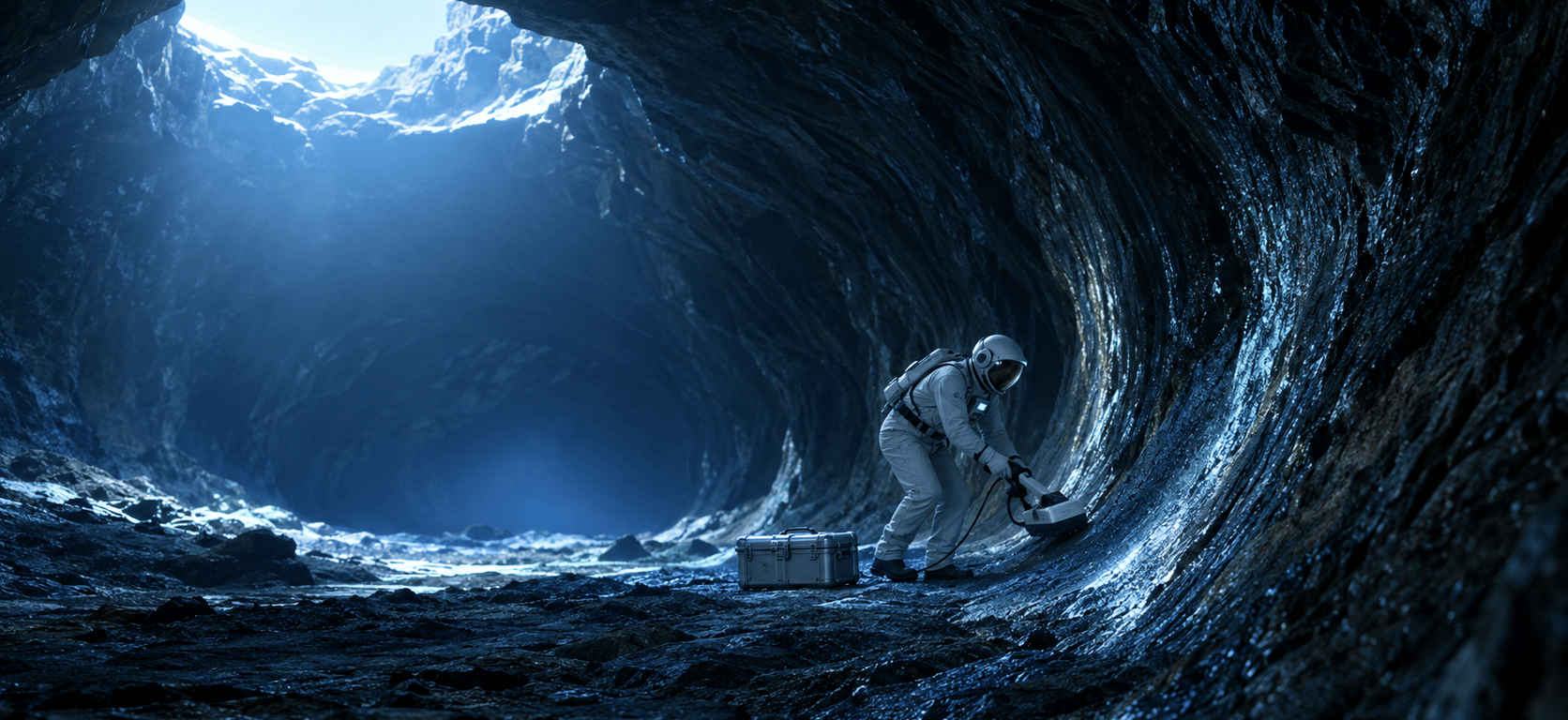
Survival school comes first. Before pouring any foundation, NASA wants to learn how to get through the lunar night. In a September 30 release, NASA announced three science suites selected through its PRISM program, all riding on commercial landers under its CLPS service. Nicky Fox, associate administrator of NASA’s Science Mission Directorate, describes them as a survival guide that reaches the surface before the crews do. The release gives no launch date and no budget.
Three instruments, three worries. LEMS-SP will watch the south pole for falling micrometeoroids, gases in the Moon’s thin outer atmosphere and moonquakes, then rate the risk to hardware. GIMLI will scan beneath the Marius Hills pit for a lava tube, a tunnel left by ancient lava flows, which could serve as a ready-made shelter with stable temperatures and radiation shielding. DISCO will measure ice on the ground in cold traps, permanently shadowed craters, and test how engine exhaust disturbs the soil.
Cave Hunting Before House Hunting
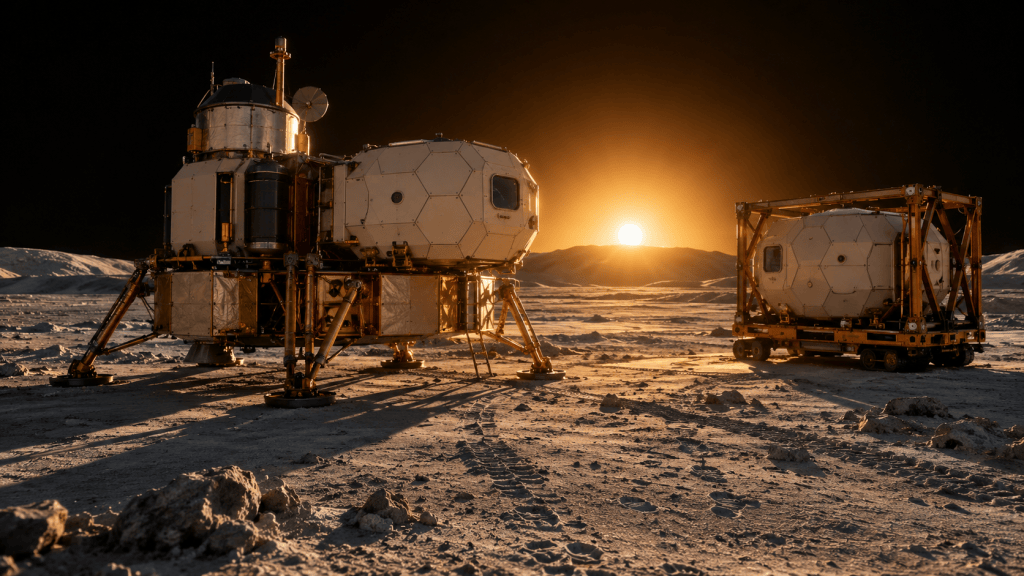
Ambition reads faster than data. NASA Administrator Jared Isaacman told Newsmax « It gives us the means to build potentially a small city on the surface of the moon, on the lunar south pole. » Yet whether that shelter exists is exactly what GIMLI has yet to find out, and the lunar water math already suggests villages fare better than cities. At the Johns Hopkins University Discovery Series, Astrolab CEO Jaret Matthews compared the effort to laying a railroad west before anyone needs it. His company has 18 months to deliver a crewed rover that must last a year and survive several lunar nights. Apollo’s, he noted, was essentially a golf cart that lasted about three days.
No ribbon-cutting expected. Shatel Bhakta, principal systems engineer for NASA’s moon base program, said at the same event « I don’t think there’s going to be one moon base event that will say, ‘All right. Now we’re operational. We’re going human rated.' » The first plan can pivot as data comes in. A base that learns before it builds could spend fewer launches on mistakes, and for a base meant to last, that counts as a sustainability gain.
[Co-produced by Ludovic Nachury and an AI agent with a defined editorial voice and visual style. Illustrations are AI-generated. Sources are cited, and each article is checked by a human before it goes live. How this works.]

