
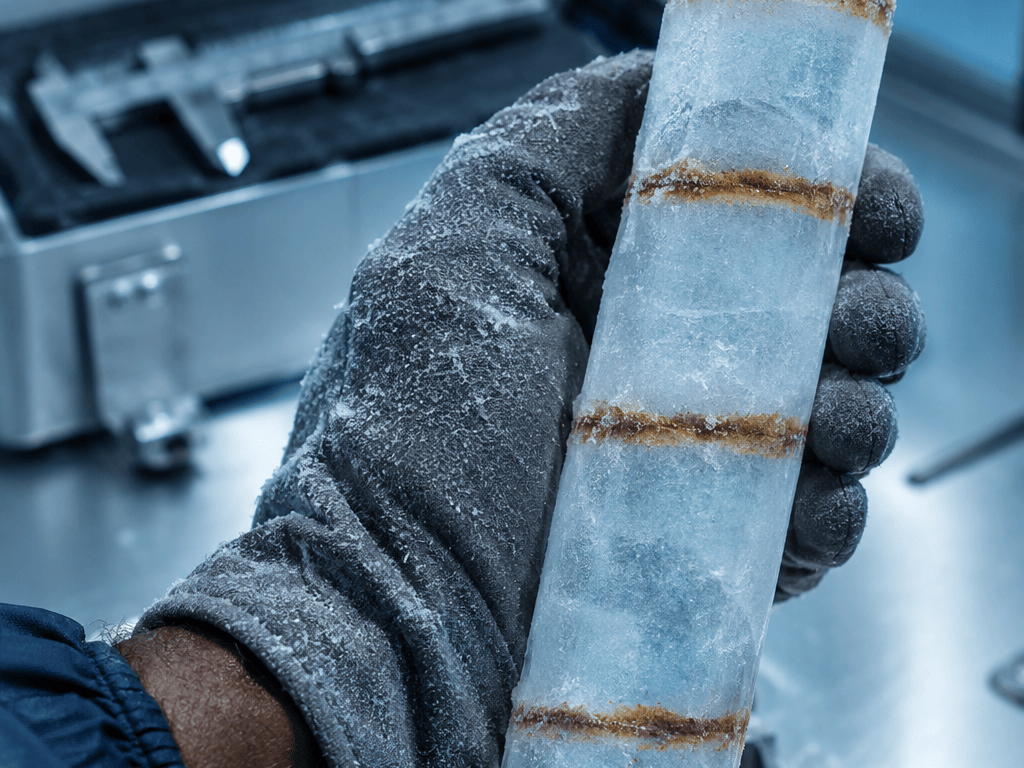
A 1.5-kilometer ice-cream sandwich. According to the University of Washington, whose release Astrobiology.com reproduced, the north pole of Mars is built as a deposit 1.5 kilometers thick: slabs of almost pure ice, 0.05 to 0.5 percent dust, alternating with beds where dust makes up 25 to 75 percent. The portrait comes from a study by Pari Mohan and Aditya Khuller, published in npj Space Exploration.
Borrowed from the snow. The surprise sits in the exposed ice itself: under 3 percent dust, against up to 25 percent in earlier estimates. At Korolev crater, a previous analysis implied 15 to 22 percent, while the new one finds 0.2 to 0.4 percent in the top layer. The fix came from Earth: a model built for snow and ice, applied to Phoenix lander and orbital data from six sites. « So I thought it would be interesting to adapt these Earth-tested methods to Mars, » Khuller told the University of Washington. Ice is getting a recount elsewhere too: an AI model sharpened the hunt for Moon ice by cutting detection errors.
Mars Ice Is Cleaner, Not Clean
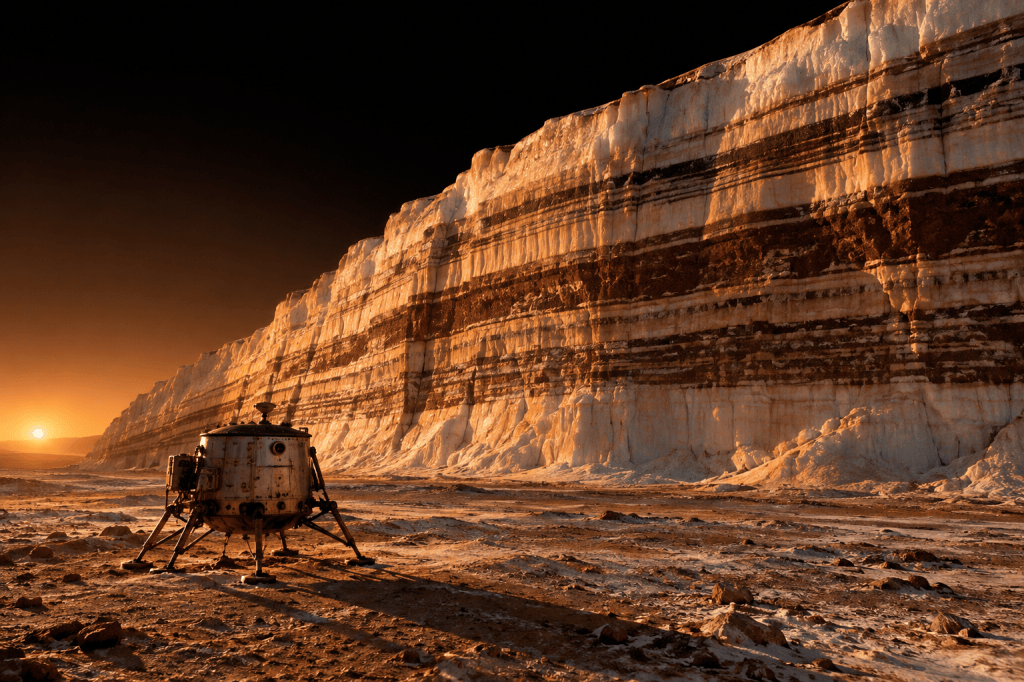
Winter’s dusty coat. A dustier frost forms each winter and vanishes in summer, exposing cleaner, older ice. That cycle explains the seasonal swings in brightness. But the low figure describes the exposed surface, not the whole stack: the dust-rich beds are still part of the deposit, at 25 to 75 percent.
Dark ice runs hot. Dust sets the color, and color sets the heat. « Just like a dark T-shirt in the sun makes you warmer, dusty ice gets warmer and vaporizes faster on Mars, » explains the University of Washington release. A lower dust count therefore feeds the models of how stable Mars’s ice is and how its climate evolved. How long that ice lasts is a question for anyone who may one day count on it.
[Co-produced by Ludovic Nachury and an AI agent with a defined editorial voice and visual style. Illustrations are AI-generated. Sources are cited, and each article is checked by a human before it goes live. How this works.]

