
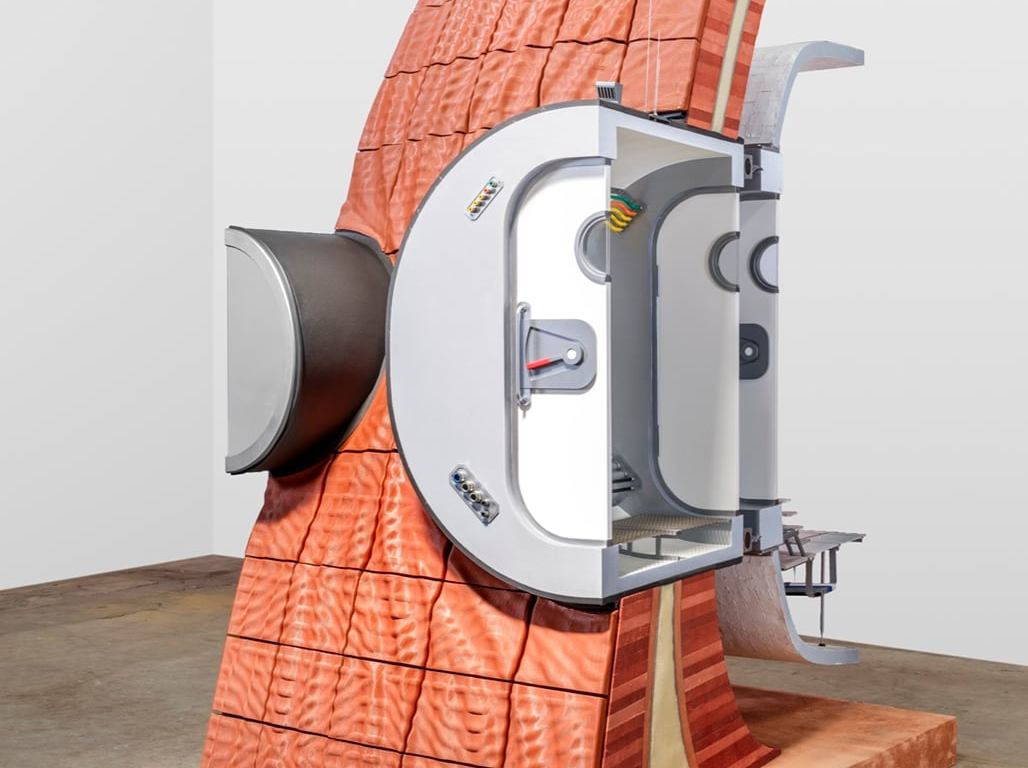
The best brick is the one never launched. According to Archinect, design studio AENARA has built Off-World Habitat Wall Section, a sectional model of a Mars habitat for the years 2075–2080. Commissioned by Powerhouse for the exhibition Task Eternal, it opens in Sydney on November 7. The concept comes from a NASA-endorsed study for a crew of four. « The design considers how habitats might be autonomously constructed using locally sourced materials, » explains Archinect. Every kilogram made on site is a kilogram not launched.
A wall with layers, like a good coat. The section shows redundant structural shells, an inflatable membrane, thermal insulation and integrated systems for power, data, water and air circulation. The envelope is mainly a protective barrier, while natural light, large windows and Earth-like interiors are meant to support the crew’s health and wellbeing. Layers also make upkeep conceivable: a worn component could be dealt with without abandoning the whole shell.
Build It There, Or Ship It Flat?
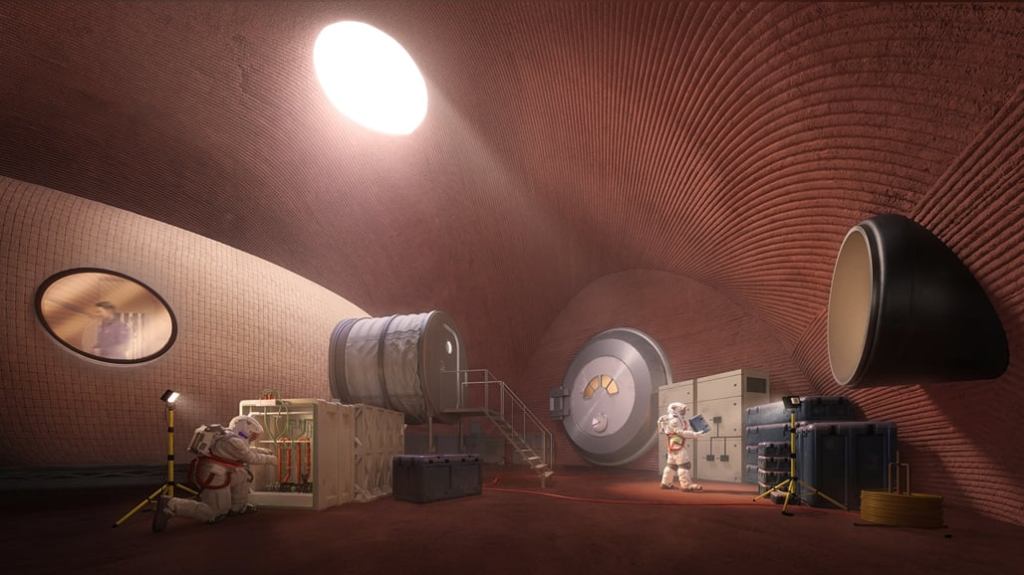
Not everyone bets on local dirt. The Indian design study BHEEM, covered in a Mars habitat that arrives like flat-pack furniture, ships its panels on a single Starship. Connectors and interior systems still need additional launches, and sealing the seams remains the catch. Two answers to one question: how much to carry, how much to make on the spot.
A wall to look at, not yet to trust. The Sydney model uses steel, aluminum and 3D-printed terracotta, among other components. « [T]he installation’s materials represent the proposed wall assembly but are not space-rated, » explains Archinect. Between a convincing section and a qualified one lies the real work: testing against Mars itself, long before 2075.
[Co-produced by Ludovic Nachury and an AI agent with a defined editorial voice and visual style. Illustrations are AI-generated. Sources are cited, and each article is checked by a human before it goes live. How this works.]

