

Concrete you can drink? According to USA Today, NASA’s VIPER rover is due to launch in late 2027 for a roughly 100-day mission near the Moon’s south pole. It will visit craters that stay in permanent shade, where ancient water ice is described as frozen hard as concrete and mixed into the dust. The rover is about the size of a golf cart.
Cancelled, then un-cancelled. Finding ice is not the same as owning a resource. VIPER was cancelled in 2024 and restarted in 2025, so even the search has proved fragile. Before anyone drinks, the rover must establish how much water there is, what it carries (lead and other toxic substances, or anything that could damage a rocket engine) and where it came from: micrometeorites or ancient lunar volcanoes.
Ice Hunting Runs on Night Shifts
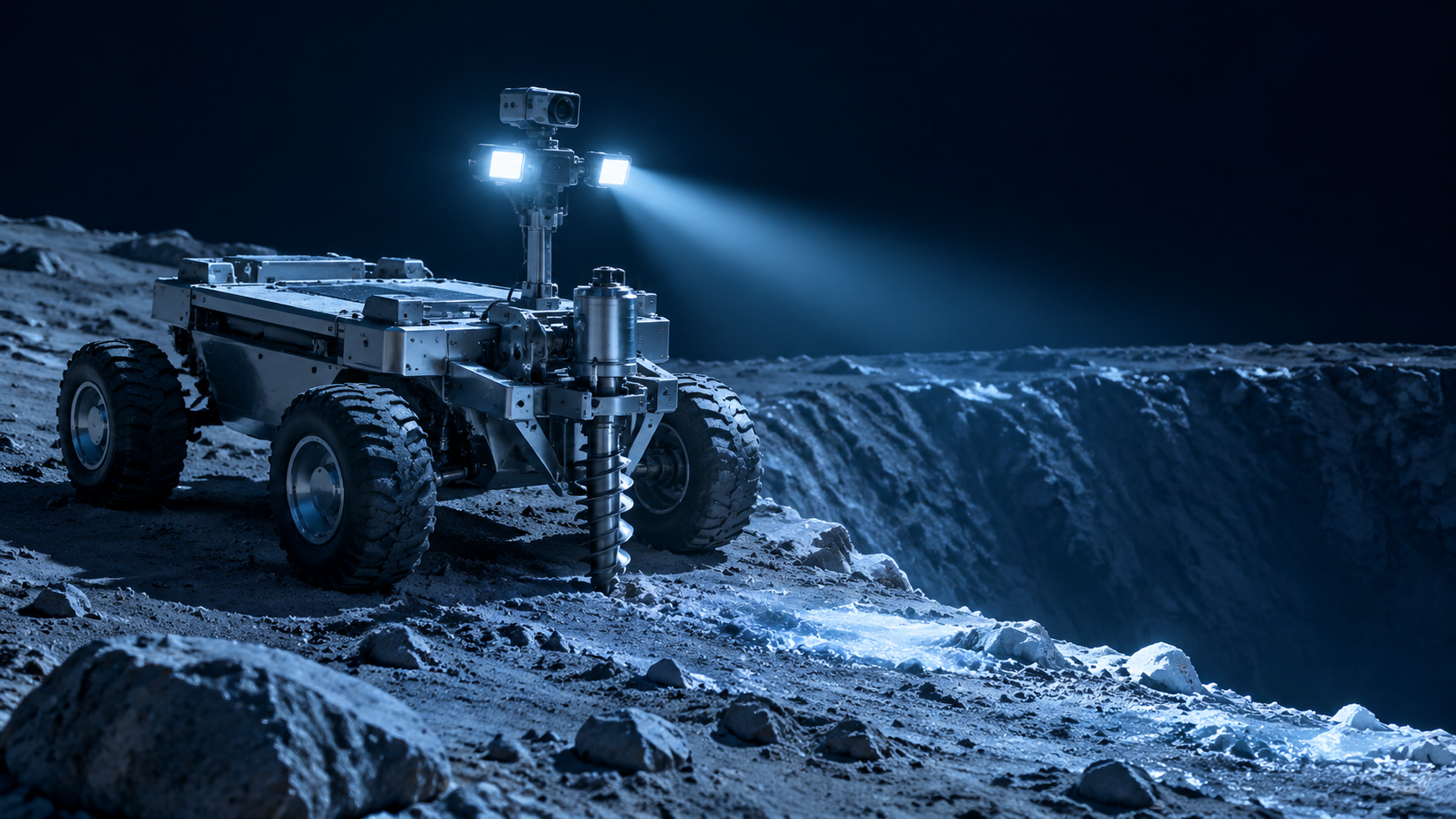
A rover with headlights. The answers rely on a neutron spectrometer, a drill, a camera and headlights to light up the shade. Ground checks of lunar ice come in several forms, including a sensor built into a rover’s wheel. On Earth, Kathleen Mandt, science lead at NASA’s Goddard Space Flight Center, will relay between scientists and drivers, with teams working in shifts around the clock. Mandt told USA Today « It is going to be very hectic. »
Drink, breathe, refuel. NASA hopes to drink the ice and process it into oxygen and rocket fuel on the Moon, so these supplies need not travel from Earth, and the Moon could serve as a launch pad toward Mars. Learning where the ice came from « will help us to establish a sustainable presence on the moon, » Mandt told USA Today. The verdict on what the ice contains may therefore matter as much as how much of it there is.
[Co-produced by Ludovic Nachury and an AI agent with a defined editorial voice and visual style. Illustrations are AI-generated. Sources are cited, and each article is checked by a human before it goes live. How this works.]

