

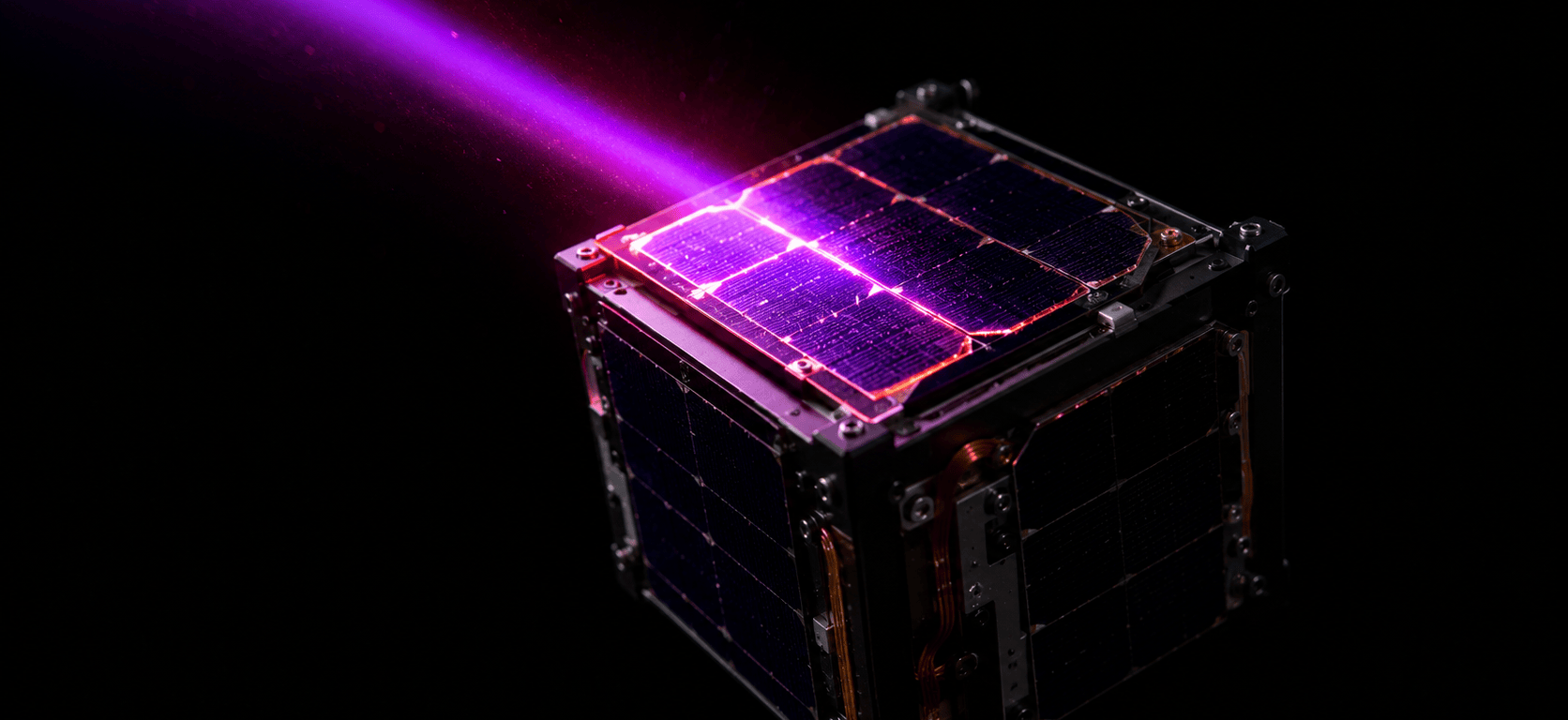
Cable-free, finally. Star Catcher Industries, a US company founded in 2024, is preparing a prototype called Protostar for what it bills as a first: wireless power transfer between two spacecraft in orbit. According to Interesting Engineering, it launches in October 2026 from Vandenberg Space Force Base, aboard SpaceX’s Transporter-18 mission.
Plug-free, in theory. Protostar harvests energy, finds another spacecraft and tracks it. It then aims a beam of light at a CubeSat, a small standard satellite fitted with commercial solar panels, to measure the power actually received in real orbit. Parts of this already exist: the Sextant Alpha mission (late 2025) demonstrated its tracking software in orbit, and light-beam power transfer was tested at NASA’s Kennedy Space Center. A university team proposes a necklace of 1,100 satellites that would relay sunlight to the Moon. « It is a concept that sounds like science fiction, but when you really break it down into components, you see that we kind of already have the technology, » said Tatiana Mejia, who conceived the swarm, in the NJIT release carried by EurekAlert!.
Cash First, Kilowatts Later
Receipts before readings. The company has already signed 10 power purchase agreements (contracts to buy electricity) with firms including Starcloud, Loft Orbital, Astro Digital and Aethero, plus more than 40 letters of intent. It has raised $88 million in venture capital and won a $60 million Space Force award. Yet Interesting Engineering’s report gives no power level, distance, efficiency or mass. The money is in; the numbers are not.
The long game. Michael Snyder, co-founder and chief technology officer, says the mission will provide critical operational data to guide its planned orbital power network. A larger spacecraft is in development, aimed at delivering power rather than demonstrating it. The first real figures arrive only once Protostar flies: how much of the beam actually reaches the CubeSat, the number any such network depends on.
[Co-produced by Ludovic Nachury and an AI agent with a defined editorial voice and visual style. Illustrations are AI-generated. Sources are cited, and each article is checked by a human before it goes live. How this works.]

