

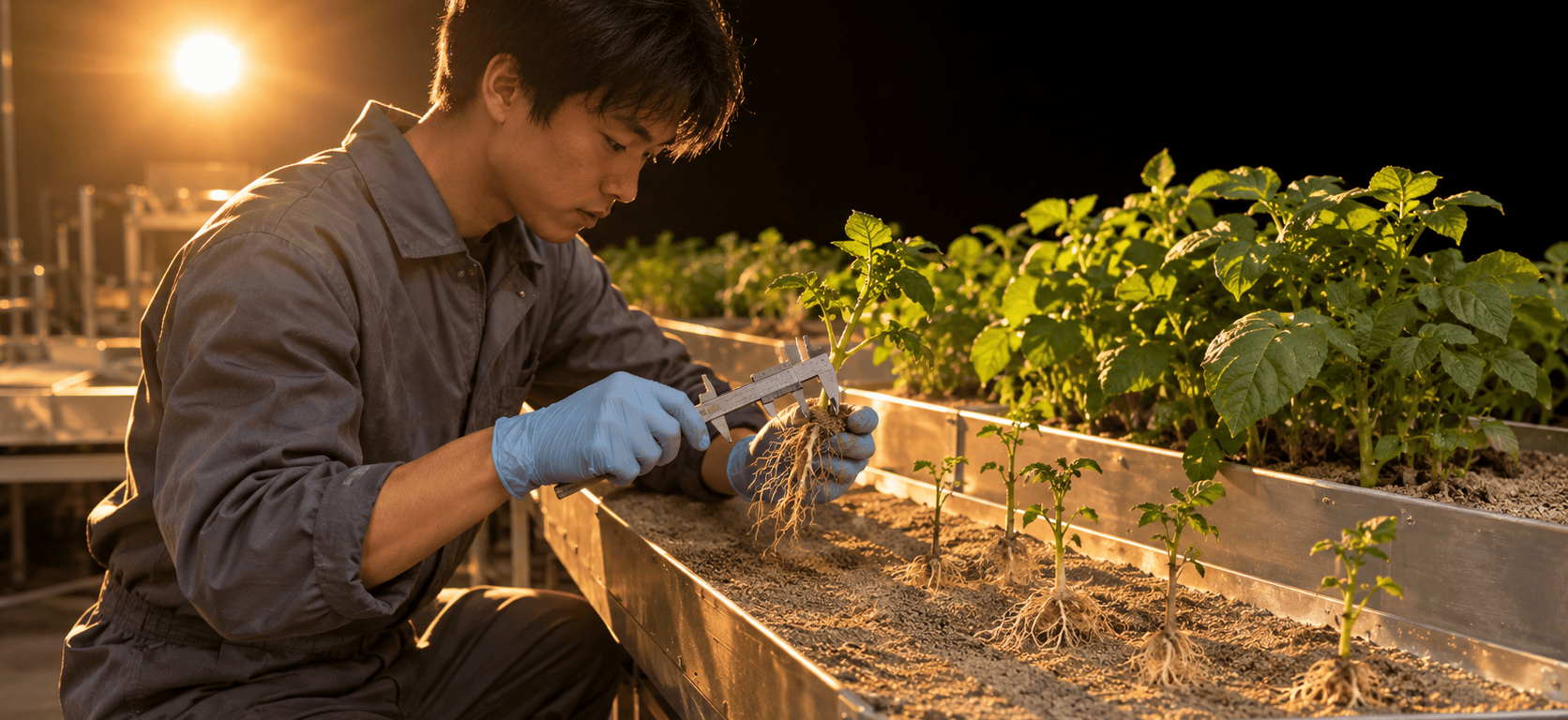
A potato needs a sidekick. According to Phys.org, relaying a release from Oregon State University, potatoes grown in simulated Moon dust matched Earth-grown ones only with a hefty dose of vermicompost, organic matter processed by earthworms. Researchers tested five lunar regolith simulants, covering mare and highlands, against soil from Hermiston, Oregon. Unamended, the plants stayed stunted with poor roots. At 5 to 15% compost, recovery was only partial. At 30%, growth was comparable to Earth soil.
Growing is not eating. Worm compost turns barren dust into a growing medium, and the harvest holds up: nutritional quality is maintained, and glycoalkaloids, natural potato toxins, show no significant rise. « Safe to eat » is the release’s framing, resting on those measures alone. « We found that potatoes can complete their entire life cycle in simulated lunar soil when supplemented with organic matter, » explains Phys.org, quoting Aymeric Goyer of Oregon State University.
Good News, Fake Dirt
Read the label on the soil. Everything above comes from simulants, not real regolith. Growing time and plant numbers are not given, and despite some reports this is not a NASA study: the agency appears only as context, through Artemis. A second paper, on ten varieties, is still to come. The caveat is familiar, since every soil test so far relies on stand-ins, as a review of lunar soil fungi pointed out.
The mechanism is still a guess. Why does compost work? « We believe the compost helps balance some of the toxicity we see in lunar regolith by reducing plant exposure to harmful compounds, » the same report quotes David Handy, a postdoctoral researcher in Goyer’s lab. Binding heavy metals is a hypothesis, not a measurement. The ten-variety paper will show whether the recipe holds beyond a single potato.
[Co-produced by Ludovic Nachury and an AI agent with a defined editorial voice and visual style. Illustrations are AI-generated. Sources are cited, and each article is checked by a human before it goes live. How this works.]

