

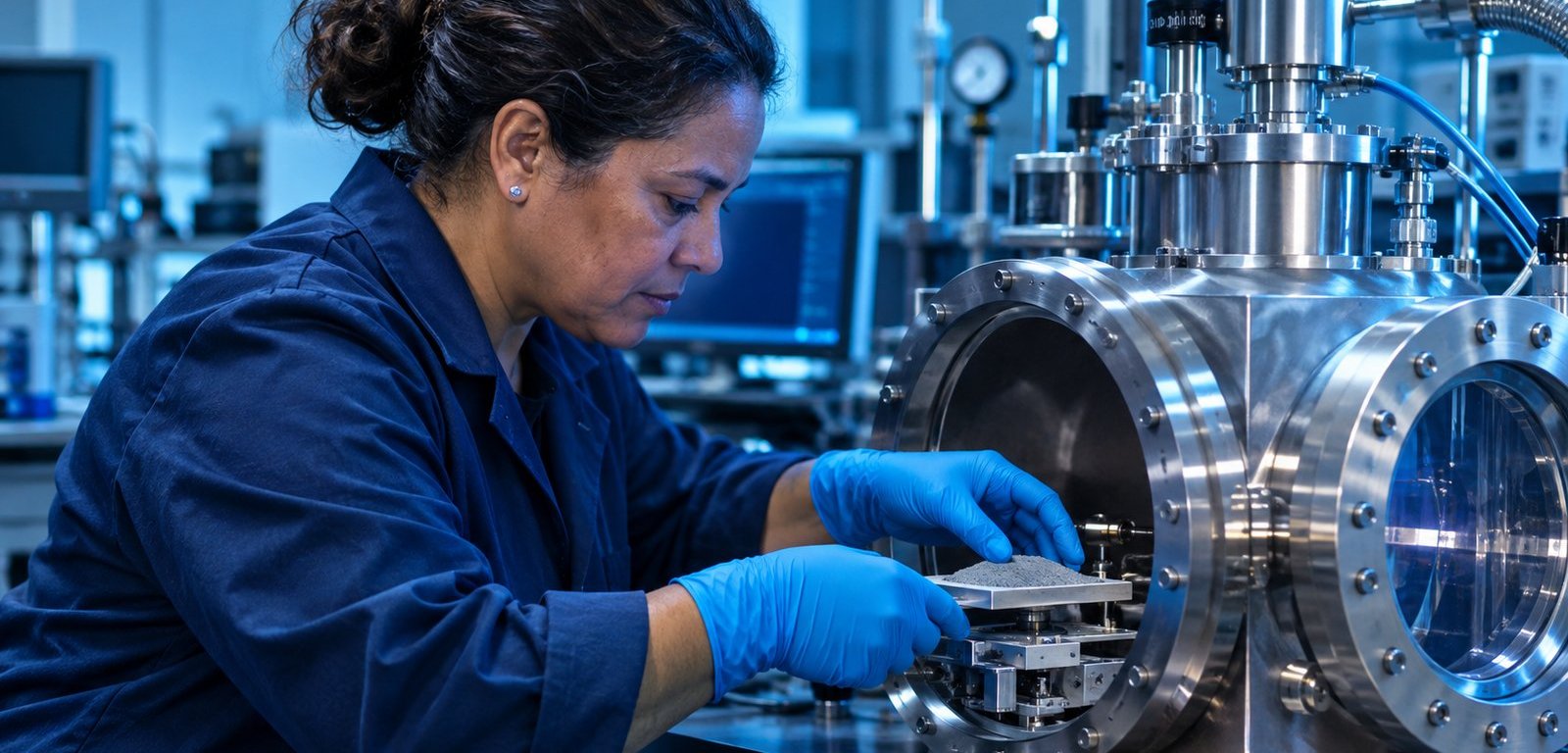
Chips off the old rock. A tool from computer chip factories can pull oxygen out of artificial Moon soil, according to Phys.org, which republished the researchers’ account from The Conversation. Their tool is plasma, an electrically energized gas. The payoff would be air and rocket propellant without costly shipments from Earth. « Oxygen is one of the most valuable resources for future space exploration, » explain Rajani K. Vijayaraghavan and Aidan Cowley in Phys.org.
No liquids required. The process is dry and draws on decades of chipmaking know-how. It also runs cooler than some rivals: the tests reached 400°C, while melting lunar dust in liquid salt takes more than 900°C. The choice of gas matters. According to the study in Scientific Reports, only sulfur hexafluoride (SF6) released oxygen gas, none at 30°C but some at 200°C. The other gas, C4F8, produced carbon monoxide and dioxide, which would still need converting.
The Moon Rock Fights Back
A crust problem. A layer of fluorides seems to form on some mineral grains, possibly choking the very reaction that frees the oxygen. The authors suggest reactors that keep the powder stirred. The fluorine would also need recycling, or Earth would have to keep shipping it. Schemes exist on paper, but this study did not test them. « Much more research is needed to understand the chemistry, to improve yields and to determine whether the process can be scaled economically, » the two researchers write in Phys.org.
Now, the bill. This proof of concept made about 0.05 grams of oxygen per hour at 400°C, while being fed 4 grams of SF6 in that hour. The authors estimate the cost at roughly 4 kilowatt-hours per gram. NASA’s MOXIE experiment on Mars needed about 0.19, although it worked from carbon dioxide in the air, not from rock. Chip factories have lent space engineers a toolbox. The energy bill will help decide whether it ever gets packed for the Moon.
[Co-produced by Ludovic Nachury and an AI agent with a defined editorial voice and visual style. Illustrations are AI-generated. Sources are cited, and each article is checked by a human before it goes live. How this works.]

