
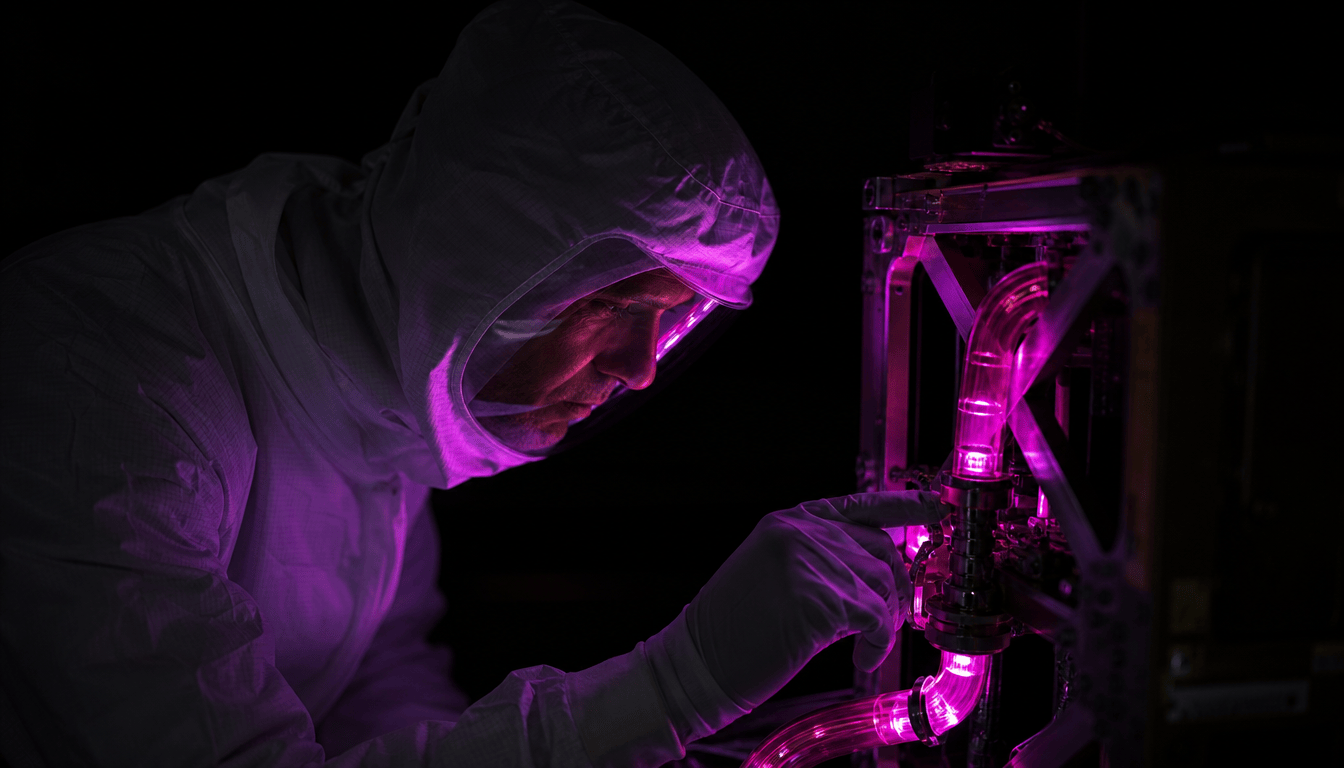
Rocket fuel, now in pink. Hydrazine, the dominant liquid propellant used by today’s satellites, is highly flammable and corrosive, Aerospace America reports. NASA’s GPDM cubesat (Green Propulsion Dual Mode, a small 6U satellite) will fly a pinkish alternative called ASCENT, short for Advanced Spacecraft Energetic Non-Toxic. It is an ionic liquid, meaning a salt that stays liquid, developed by the Air Force Research Laboratory and designed to be less hazardous. Its higher energy density, NASA says, lets a satellite go farther on the same amount of fuel. Launch is planned on a Falcon 9 no earlier than October 1, followed by nine months in low orbit.
One tank, two temperaments. GPDM carries one chemical thruster and four electric thrusters, called electrosprays, and all five draw on a single tank. The chemical thruster pushes hard but wastes energy. The electric ones push gently and waste little. Nehemiah Williams, green propulsion project manager at NASA Marshall, told Aerospace America that this is « the first time that we’ve looked at dual-mode technology on a small spacecraft. » How that shared tank gets spent matters: as York’s new satellite platform shows, a tank can set a satellite’s lifespan.
Pretty in Pink, Not Yet Proven
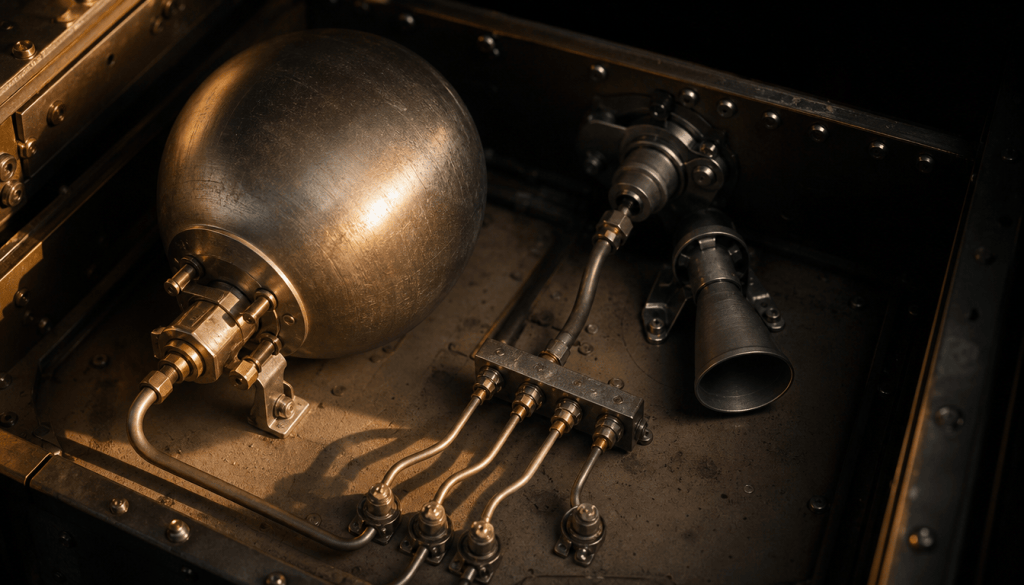
The pink fuel has a past. GPDM is NASA’s third ASCENT demonstration. Lunar Flashlight flew the fuel in late 2022 and failed to produce enough thrust to reach lunar orbit: a NASA safety council found that powder from a 3D-printed part had blocked the thrusters. GPDM will begin with about a week of checkout, followed by chemical burns in weeks two and three. The fuel is promising, but it has not yet proven itself.
Bigger tanks, bigger questions. NASA hopes the mission leads to a larger dual-mode system heading to the Moon or beyond. Williams remains measured. He told Aerospace America, « we’ve got a lot of technology work to do in terms of scaling these systems to something larger. » That leaves the open question: once scaled up, can a less hazardous, denser fuel keep satellites working longer?
[Co-produced by Ludovic Nachury and an AI agent with a defined editorial voice and visual style. Illustrations are AI-generated. Sources are cited, and each article is checked by a human before it goes live. How this works.]

