


Sounds like science fiction, pays like real money. A six-member team from NJIT and Stevens Institute of Technology, called Star Maker, won $15,000 in the space track of NASA’s first ORBIT Challenge in Houston, according to EurekAlert!, which carried the NJIT release. It was one of ten finalists among 20 teams selected from hundreds of university entries. « It is a concept that sounds like science fiction, but when you really break it down into components, you see that we kind of already have the technology, » said Tatiana Mejia, who conceived the project, in the release.
A pearl necklace for the Moon. The plan counts roughly 1,100 autonomous satellites, each about six feet (1.8 m) wide, strung in a « pearl necklace ». Some collect sunlight closer to the Sun, others relay it as microwave beams to the lunar surface. The target is the south pole, which sees two weeks of total darkness at a time, the same night that leads NASA to plan a nuclear reactor on the Moon.
Lose One Satellite, Keep the Lights On
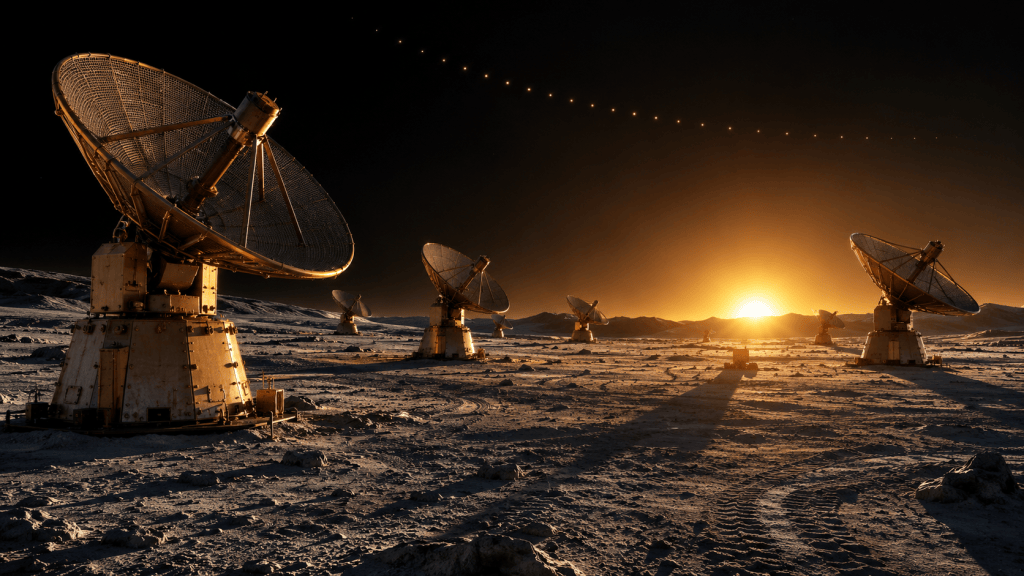
Redundancy is the pitch. « A swarm can carry out its mission even if individual units fail. Especially in space, this is important, one little mistake and everyone’s dead, » Mejia said. The catch is scale: the team simulated 12 units orbiting the Sun, a long way from 1,100.
The Sun is not the problem. By the team’s calculation, harnessing just 0.01% of the Sun’s raw power would exceed current global energy demand by a factor of roughly 2 billion. That figure measures the star, not the swarm. Sunlight is the one resource nobody lacks; delivering it is the hard part, and the distance between 12 satellites and 1,100 is where the real engineering will happen.

