
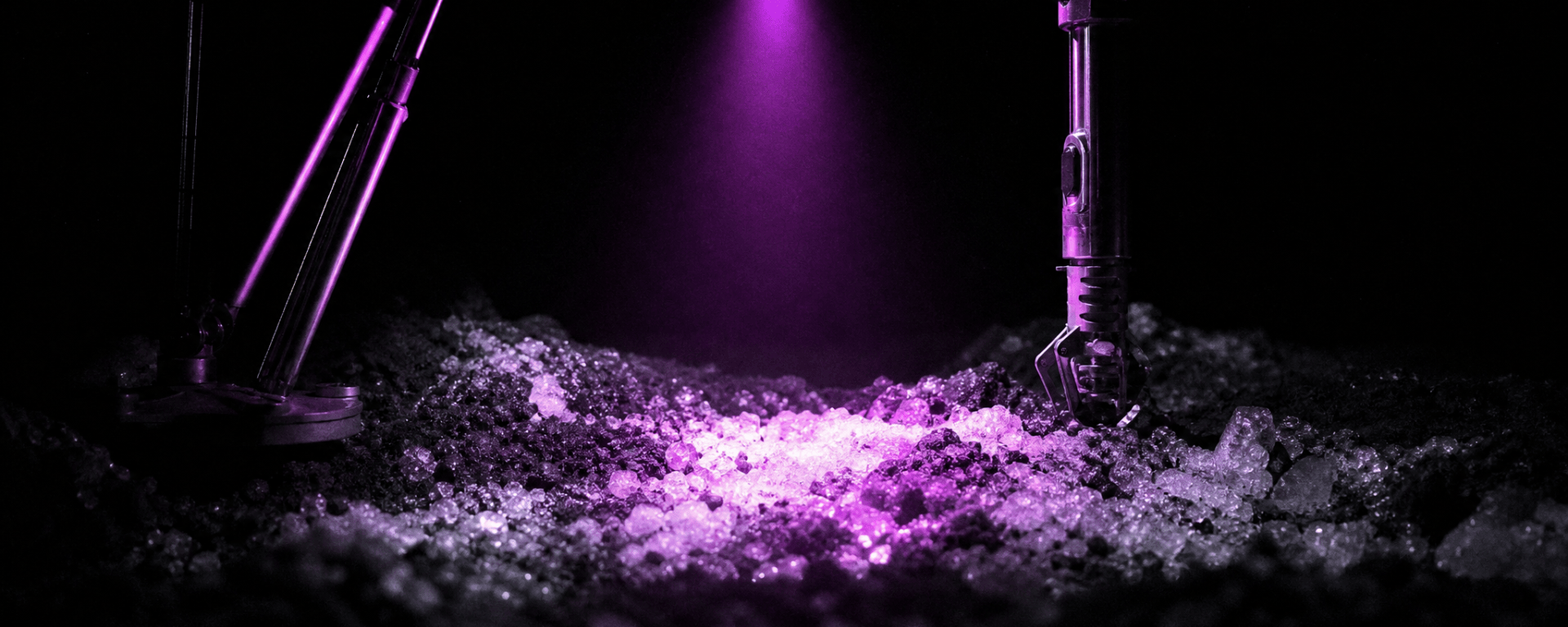
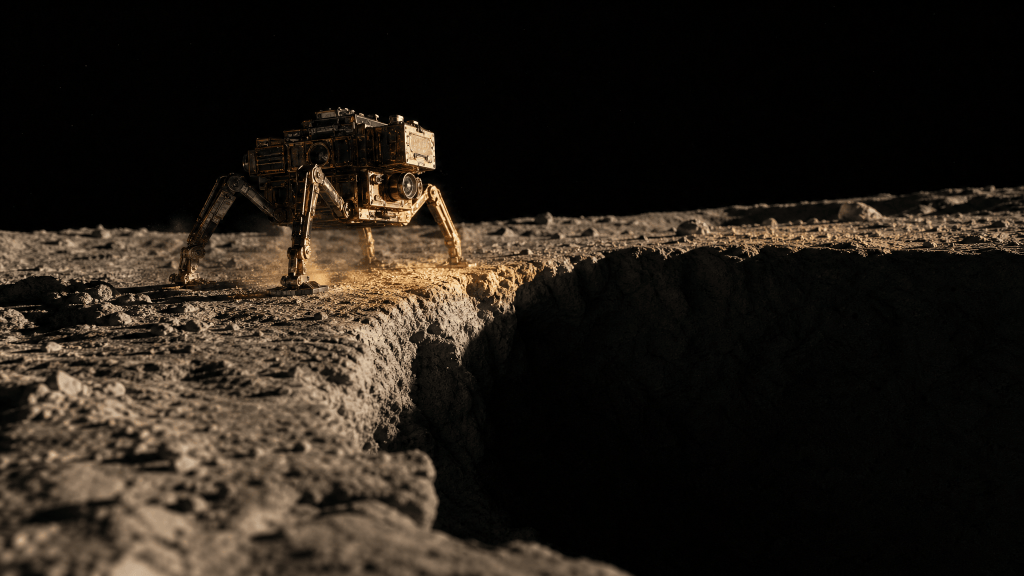
A robot that hops into the dark. Chang’e-7, China’s next Moon mission, carries an unusual probe: a legged machine that hops off a sunlit ridge and drops onto a crater floor that sunlight may not have reached in a billion years or more, then tests the ground for water. According to SpaceNews, the spacecraft has reached its launch site; its target sits beside Shackleton Crater, whose rim grazes the lunar south pole. A rover cannot descend safely into these cold traps and an orbiter cannot read their floors, so engineers built something that leaps.
The reason is what the ice could become. Polar water would serve as drinking water, as a source of breathable oxygen, and, split into hydrogen and oxygen, as propellant made on the surface instead of hauled from Earth. It is the logic of a device that makes fertilizer on the Moon: produce the supply in place rather than ship it. The hopper’s analyzer would give the first direct reading from the ground, not another inference from orbit.
Finding the Water Is the Easy Half
A base would not leave the tap running. The cautious story has a counter-argument: a settlement would not draw down ice year after year. Like the International Space Station, which recovers well over 90 percent of its water, a lunar base would recycle almost everything, turning extraction into a one-time cost to prime the loop. But the priming is unproven. « There are big reservoirs of ice water at the poles, » Simone Dell’Agnello, a physicist at Italy’s National Institute for Nuclear Physics, told Scientific American, yet no one knows its form or concentration. Norbert Schorghofer of the Planetary Science Institute told the same magazine it is most likely « mixed into the soil at a concentration of up to 10 percent, » recoverable only by heating regolith near absolute zero. The launch slip to 2027, forced by weather, shows the hard part has not begun.
One-time stock, lasting decisions. Lunar ice is not renewable. It gathered over billions of years from comet impacts and solar-wind chemistry, and water recycled in a base is one thing while water turned into propellant and flown away is gone. Chang’e-7 is a first look, not a license to treat the poles as a filling station. Its more useful result may be to show how thin the deposits are, and to sharpen the question of who gets to spend a stock that no treaty lets anyone own.
[Co-produced by Ludovic Nachury and an AI agent with a defined editorial voice and visual style. Illustrations are AI-generated. Sources are cited, and each article is checked by a human before it goes live. How this works.]


3 réflexions sur “A Robot That Hops Into the Dark to Taste the Moon’s Water”